



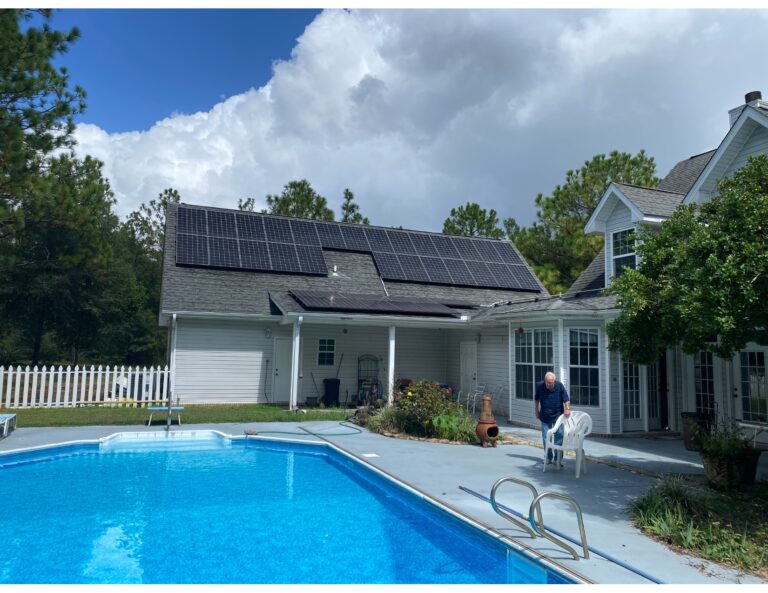
Owning a pool in Northwest Florida is a luxury, until you see the electricity bills from running your pump all year round. Fortunately, solar energy offers a sustainable way to keep your pool sparkling while cutting down those costs.
But the big question most homeowners ask is: how many solar panels do I need to run my pool pump in the Florida Panhandle?
Also Read: Solar + EV Charging at Home in the Panhandle: Sizing, Costs & Break-Even
Find us here:
Solar Cost Calculator – Florida Panhandle Only
* Estimate based on $3.25 per watt for solar installation.
* For Tesla Powerwall 3 Batteries, $15,000 for the first battery, $12,000 for each additional battery.
* Other variations and types of Batteries are available.
1. How Much Energy Does a Pool Pump Use?
- Single-speed pumps: 2,000–3,000 kWh/year (roughly 2–2.5 kW draw when running).
- Variable-speed pumps (VSPs): 900–1,500 kWh/year (because they can run longer at lower speeds).
Example: A 1.5 HP single-speed pump running 8 hours/day in Pensacola uses ~2,200 kWh per year. At Florida’s average electricity rate ($0.15/kWh), that’s $330/year just to circulate your pool.
2. How Many Solar Panels Do You Need?
Florida Panhandle cities (Pensacola, Destin, Panama City) get about 5 peak sun hours/day on average annually.
- Rule of thumb: Each standard 400W solar panel in NW Florida generates ~600 kWh per year.
So:
- Single-speed pump (2,200 kWh/year) → needs about 4 solar panels.
- Variable-speed pump (1,200 kWh/year) → needs about 2 solar panels.
Of course, shading, tilt, and seasonal weather affect output, so adding 10–20% buffer is smart.
3. Why Variable-Speed Pumps Are a Game-Changer
If you’re upgrading to solar, pairing it with a variable-speed pump maximises savings. Why?
- Uses up to 65% less power.
- Runs longer at lower speeds → keeps water cleaner with less strain.
- Works well with smaller solar arrays (lower upfront cost).
Many Florida utilities even offer rebates for switching to VSPs.
4. Seasonal Tilt Tips for Pool Owners
Solar production changes with the seasons in the Panhandle:
- Summer (long days, high sun): Panels at ~20° tilt match overhead sun.
- Winter (shorter days, lower sun angle): Panels at ~35° tilt give better performance.
If you have a fixed roof, aim for a middle ground of 25–30° tilt, perfect for year-round pool operation in NW Florida.
5. Should You Go Off-Grid or Grid-Tied?
- Grid-tied: Extra solar power offsets your home’s bill; excess goes back to the grid.
- Battery-backed: Keeps your pump running during outages (popular in hurricane-prone areas).
- Dedicated pool solar system: Rare but possible, usually less flexible than whole-home solar.
6. The Bottom Line
For most pool owners in the Florida Panhandle:
- 2–4 solar panels are enough to run your pump year-round.
- A variable-speed pump makes the system cheaper and more efficient.
- Smart tilt adjustments (or a fixed compromise angle) boost annual output.
By combining pool solar with your household system, you can slash your energy bills while enjoying crystal-clear water, powered by Florida’s abundant sunshine.
Next Step: Want a custom solar quote for your pool and home in NW Florida?
Contact MSM Solar LLC today, we’ll size your system based on your actual pump model, usage, and roof space.
