



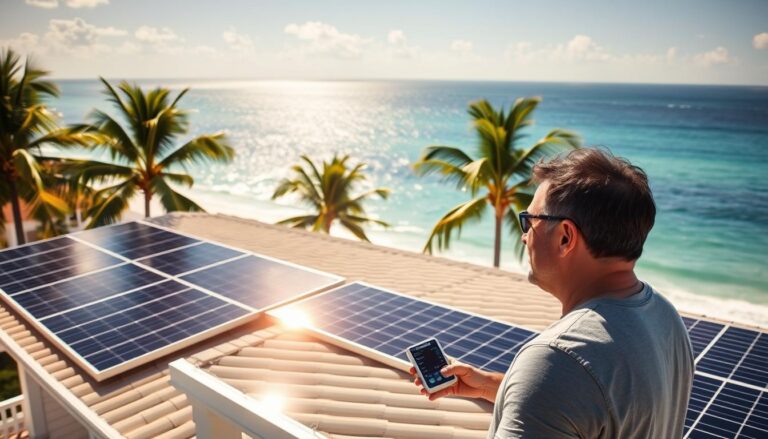
For homeowners in the Florida Panhandle, solar isn’t just about cutting bills, it’s also about how your home looks. Many live in HOA-governed communities where curb appeal is king, and neighbours (and review boards) watch closely. The good news: with the right equipment and presentation, you can design a solar array that blends seamlessly with your home’s architecture.
This guide covers aesthetic choices, conduit routing, skirt kits, and how to build a sample ARC packet to secure approvals. If you’re in Walton, Santa Rosa, Okaloosa, or Bay County, this will help you install solar without running into HOA roadblocks.
Also Read: Post-Install Checklist: 30/90-Day Tasks to Keep Your New Array at Peak Output
Solar Cost Calculator – Florida Panhandle Only
* Estimate based on $3.25 per watt for solar installation.
* For Tesla Powerwall 3 Batteries, $15,000 for the first battery, $12,000 for each additional battery.
* Other variations and types of Batteries are available.
Florida’s Solar Rights vs. HOA Rules
First, a quick legal refresher: Florida’s Solar Rights Act prevents HOAs from banning solar outright. However, HOAs can regulate placement for aesthetics as long as changes don’t significantly impact performance.
That means:
- Your HOA can’t deny solar completely.
- They can request adjustments, like moving panels from the front roof plane to the rear, if efficiency isn’t reduced by more than 10%.
- You’ll need to submit an Architectural Review Committee (ARC) packet with design details before breaking ground.
Low-Profile Panels: Blending with Your Roof
Modern solar panels aren’t the shiny blue modules of a decade ago. Today’s low-profile designs integrate cleanly with coastal and suburban rooflines.
- All-black modules: Black cells, frames, and backsheet create a sleek, uniform look.
- Low-profile mounting rails: Keep panels closer to the roof, reducing visible gaps.
- Flush-mount orientation: Panels aligned with roof slope (instead of tilted) improve curb appeal.
In upscale communities along 30A or Destin, these design choices are often the difference between a smooth ARC approval and multiple rounds of revisions.
Wire & Conduit Routing: Out of Sight, Out of Mind
Visible conduit is one of the quickest ways to spoil the look of a solar install. Smart routing makes wiring nearly invisible:
- Attic routing: Whenever possible, run wires inside attic spaces rather than across shingles.
- Painted conduit: If external conduit is required, it should be painted to match roof or siding.
- Hidden junction boxes: Locate boxes under panels or near roof ridges to minimise visual impact.
These small touches signal professionalism and care, something HOA boards pay attention to.
Skirt Kits & Finishing Touches
“Skirt kits” are trim pieces that run along the edge of solar arrays. They serve no functional purpose but dramatically improve the visual finish.
- Hide wiring & rails: Skirts block the view of shiny metal hardware.
- Smooth edge lines: Arrays look more like skylights or integrated roof features.
- Premium look: Especially important in HOAs where aesthetics drive property value.
While they add a bit of cost, skirts are one of the easiest ways to keep both boards and neighbours happy.
Building a Sample ARC Packet
To speed up HOA approval, prepare a professional-looking packet that answers common board concerns. Include:
- Cover letter – State intent, emphasise compliance with Solar Rights Act.
- Site plan – Show where panels will be located on your roof.
- Elevation renderings – Before-and-after images highlighting low-profile, all-black design.
- Product spec sheets – For panels, racking, and inverters (with Florida Product Approval numbers).
- Warranty & installer information – Build confidence in system quality.
- Wire management plan – Note conduit routing and skirts to show aesthetics are prioritised.
A polished packet not only earns faster approval but reassures the board that you’ve thought through their concerns.
Bonus: Landscape Screening for Ground-Mounts
If your HOA restricts visibility of ground-mounted arrays, landscaping can solve it.
- Hedges or trellises: Shield arrays without blocking sunlight.
- Native vegetation: Palmettos, wax myrtles, and other local species blend naturally.
- HOA win-win: You get solar, they get curb appeal preserved.
Real Example: Walton County HOA Approval
A homeowner in Santa Rosa Beach wanted a 7.2 kW solar array visible from the street. The HOA initially resisted, citing curb appeal. The installer submitted:
- Renderings of all-black panels with skirt kits.
- A wiring plan with attic conduit routing.
- A guarantee of no visible junction boxes.
The board approved unanimously on the second review, showing that details matter.
Key Takeaways
- HOA solar in the Florida Panhandle is protected by state law, but aesthetics play a big role in approvals.
- Use all-black, low-profile panels and skirt kits for a polished look.
- Plan hidden conduit routing to keep wiring out of sight.
- A strong ARC packet with visuals and specs can speed approval.
- Pair good design with legal knowledge to keep both your HOA and your neighbours happy.
Final Word
Solar and HOAs don’t have to clash. By prioritising curb appeal, careful wire management, and clean finishing touches, Panhandle homeowners can install solar that adds value without sacrificing aesthetics. With the right packet and product choices, your board is more likely to say “yes”, and your neighbours may even thank you for raising the bar.
