



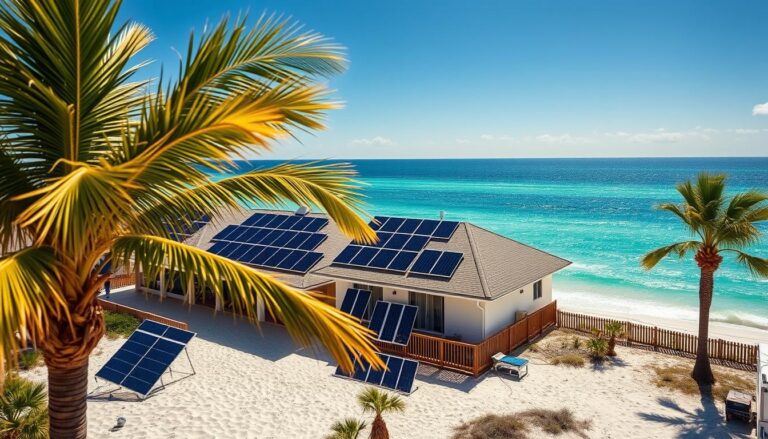
Living by the beach in Florida’s Emerald Coast, whether in 30A, Panama City Beach, or Destin, means stunning views, salty breezes, and plenty of sunshine. But for solar homeowners, that same salty air can be tough on solar systems. Coastal salt spray and corrosion are real risks that can shorten the lifespan of your panels and racking if you don’t plan properly. Here’s how to protect your investment.
Find us here:
Solar Cost Calculator – Florida Panhandle Only
* Estimate based on $3.25 per watt for solar installation.
* For Tesla Powerwall 3 Batteries, $15,000 for the first battery, $12,000 for each additional battery.
* Other variations and types of Batteries are available.
Also Read: HOA & Permitting Rules for Solar by Panhandle County (2025 Guide)
1. Why Salt Spray Matters for Solar
Salt carried by coastal winds deposits on panels and metal hardware. Over time, this can:
- Pit and corrode aluminium frames
- Rust steel fasteners if they aren’t treated
- Reduce panel efficiency from salt film buildup
- Compromise wiring and connectors
In Florida’s Panhandle, where humidity and storms are common, these risks are amplified.
2. Choose Marine-Grade Racking & Components
Not all racking is created equal. For homes within 5 miles of the coast:
- Opt for marine-grade aluminium with a higher anodisation layer (Class I, 0.7 mil or thicker).
- Use 316 stainless steel fasteners (much more corrosion-resistant than 304 grade).
- Ensure rails and clamps are bonded and coated for marine environments.
Pro Tip: Always ask your installer whether the racking system has a marine-grade warranty.
Also Read: Pool Owners: Run Your Pump with Solar – What Size System Do You Need in NW Florida?
Panel Selection: Corrosion-Resistant Certifications
When shopping for solar panels in coastal Florida, look for:
- IEC 61701 (Salt Mist Corrosion Testing) certification – Panels tested for long-term exposure.
- Double-glass modules – Better sealing against moisture.
- Encapsulant quality – EVA layers that resist delamination in high humidity.
4. Fastener & Sealant Choices
Small hardware often makes the biggest difference in corrosion:
- Bolts, nuts, and washers: Use 316 stainless steel only.
- Roof penetrations: Always sealed with UV- and salt-resistant flashing/caulk.
- Avoid galvanised steel, it corrodes fast in salt environments.
5. Wash Schedule & Maintenance in NW Florida
Coastal solar systems need more attention than inland installs:
- Rinse panels monthly with low-pressure fresh water to remove salt film.
- After storms/hurricanes: Inspect for corrosion spots or water intrusion.
- Annual professional inspection: Ensure grounding, rails, and connectors are free of rust.
If you live directly on the beach, a bi-weekly rinse during peak salt spray seasons (spring/summer) may be worthwhile.
6. Protecting Against Long-Term Wear
Other strategies for beachside solar in 30A, PCB, and Destin:
- Install bird/squirrel guards to prevent salt and debris buildup under panels.
- Ensure your system has coastal surge protection (lightning + salt spray corrosion is a bad mix).
- Consider an extended maintenance plan with a local installer familiar with marine conditions.
7. The Bottom Line
Solar works beautifully in Florida’s coastal towns, but only if you protect against corrosion. By choosing marine-grade racking, anodised aluminium, stainless fasteners, and salt-resistant panels, plus following a regular wash schedule, you can keep your system producing clean energy for 25+ years, despite the salty air.
Next Step: If you live in 30A, Destin, or Panama City Beach, MSM Solar LLC can design a coastal-hardened solar system for your home. Get in touch today for a free consultation.
