



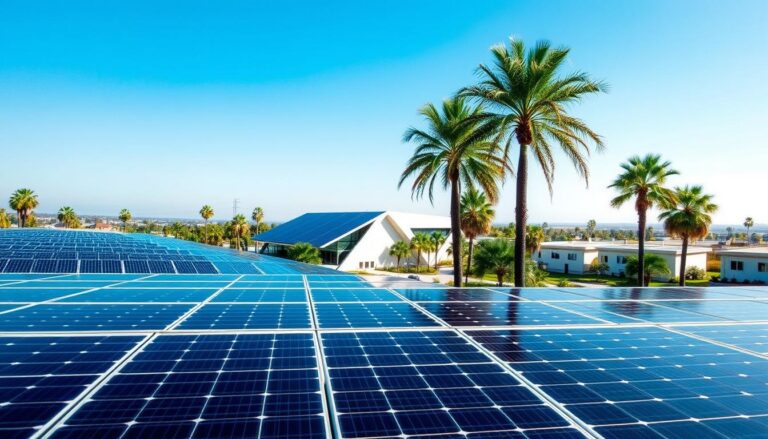
As energy costs rise across the Florida Panhandle, more condo associations and multi-unit property managers in Panama City Beach are exploring solar power to offset utility bills and boost property value.
But going solar for a condominium or HOA-managed complex isn’t as simple as a single-family installation. Shared ownership, roof rights, and Florida’s HOA laws all come into play, making condo solar both an exciting and complex opportunity.
Also Read: Solar Licensing & Permit Requirements in Escambia & Santa Rosa Counties (2025 Update)
In this 2025 guide, we’ll break down what HOA boards in Panama City Beach, FL need to know about solar systems for condos and multi-unit properties, including ownership models, approval processes, and the latest Florida statutes that protect residents’ right to install solar.
Solar Cost Calculator – Florida Panhandle Only
* Estimate based on $3.25 per watt for solar installation.
* For Tesla Powerwall 3 Batteries, $15,000 for the first battery, $12,000 for each additional battery.
* Other variations and types of Batteries are available.
Why Condo Communities Are Considering Solar
Condo associations across the Gulf Coast are eyeing solar for a mix of financial and environmental reasons:
- Rising utility costs: Florida Power & Light’s commercial rates increased again in 2024, driving up operating expenses for common areas.
- Statewide 30% tax credit: Associations can benefit through passthrough or direct-pay structures under the Inflation Reduction Act (IRA).
- Eco-conscious buyers: Solar-equipped buildings attract younger, sustainability-focused buyers and renters.
- Storm resilience: Pairing solar with battery storage keeps elevators, security systems, and emergency lighting powered during outages.
For Panama City Beach, where summer A/C use and pool pumps drive high electric bills, solar can trim thousands off annual operating costs while strengthening marketing appeal for future residents.
Florida Law Protects Individual Condo Owners’ Right to Solar
The good news: Florida Statute 163.04 prevents HOAs or condo associations from prohibiting renewable energy devices like solar panels outright.
However, it distinguishes between single-family homes and multi-unit buildings:
- Single-family homes: Owners can install solar on their roof if they follow design guidelines (color, conduit routing, etc.).
- Condominiums: Because roofs are typically common property, individual unit owners must receive board approval before installing solar or shared systems.
In other words, the right to go solar exists, but the HOA or condo board controls how it’s implemented.
Three Common Solar Models for Condos & Multi-Unit Properties
Shared/Common-Area Solar System
The most popular model for Panama City Beach condos involves installing a centralized solar array on the roof, carports, or common land to power shared loads like:
- Pool pumps
- Elevators
- Exterior and lobby lighting
- Clubhouse HVAC
- Security gates
The HOA owns the system, pays for installation (or finances it), and uses the energy savings to reduce common-area electricity bills.
Advantages:
- Simple ownership structure.
- One meter and one electric account.
- Eligible for federal 30% Direct Pay tax credit (for nonprofit HOAs under IRA rules).
Disadvantages:
- Does not directly offset individual unit bills.
- Requires HOA vote and budget allocation.
Individually Metered Solar Systems (Per Unit)
Each condo owner installs solar panels on their portion of the roof or a balcony canopy, connecting directly to their own electrical meter.
Advantages:
- Personal investment and incentive claim.
- Independent billing and savings.
Disadvantages:
- Complex roof rights and shading considerations.
- May require structural analysis and board policy to manage shared roof space.
Florida law allows this setup only if the condo declaration or board policy defines clear boundaries for roof use and maintenance responsibility.
Community or Virtual Solar Program
If rooftop access is limited, condos can subscribe to offsite solar farms through community solar programs offered by Florida Power & Light (FPL SolarTogether).
Advantages:
- No onsite installation.
- Credits applied to shared or individual electric bills.
- Minimal maintenance and no HOA structural responsibility.
Disadvantages:
- Lower long-term ROI compared to owning panels.
- Subscription caps and waiting lists.
For Panama City Beach condos with limited roof space or strict architectural covenants, this is often the easiest entry into renewable energy participation.
What HOA Boards Should Evaluate Before Approving Solar
When a condo owner or the board itself proposes a solar project, consider these five due diligence steps before approval:
1. Roof Ownership & Maintenance Responsibility
Review the Condominium Declaration to determine whether the roof is common or limited common element.
- Common roofs: Require HOA ownership and maintenance responsibility.
- Limited roofs (e.g., townhouse-style condos): May allow individual ownership with conditions.
2. Structural Engineering Review
Florida Building Code requires a PE-stamped structural analysis for all rooftop solar installations. Condo roofs must confirm:
- Rafter spacing and load capacity.
- Wind uplift resistance (per ASCE 7-22, 160 mph coastal rating).
- Roof warranty compatibility with penetrations.
3. Electrical & Metering Configuration
If powering common areas, panels typically feed the master meter or common load panel.
For unit-level systems, each must tie into that owner’s dedicated meter.
4. Insurance & Liability Coverage
Confirm whether solar equipment is covered under the HOA’s master insurance policy or requires separate coverage.
Most insurers in Florida now recognize solar as a covered structure if properly permitted.
5. Maintenance & Access Policies
Establish clear policies for:
- Panel cleaning and service intervals.
- Access for maintenance crews.
- Roof repair cost-sharing between owners and HOA.
Permitting in Panama City Beach
Solar projects in condos and multi-unit structures require permits from the Panama City Beach Building Department under Bay County jurisdiction.
Required submissions include:
- Building and Electrical Permit Application
- PE-stamped structural drawings and load calculations
- Site plan with array location and setbacks
- Electrical one-line diagram
- Product approval sheets for racking and modules (Florida Product Approval or Miami-Dade NOA).
Average review timeline: 7–12 business days.
Permit fees typically range from $200–$350 depending on valuation.
HOA & ARC Approval Process
Before submitting for permits, most Panama City Beach HOAs require an Architectural Review Committee (ARC) approval.
Typical documentation includes:
- Rendered panel layout with roof elevation views.
- Conduit routing diagram showing concealed paths.
- Color-matched panels and racking (black-on-black preferred).
- Reference to Florida Statute 163.04, confirming compliance.
ARC reviews usually take 2–4 weeks, but boards can speed up approvals by adopting pre-approved solar guidelines.
Example: 2025 Solar Policy for Condo Boards
Here’s a sample framework that Panama City Beach HOA boards can use to govern solar requests:
Policy Title: Condominium Solar Energy Device Policy (2025)
Purpose: To allow responsible installation of renewable energy systems while maintaining aesthetic and structural integrity.
Key Provisions:
- Solar devices must comply with Florida Statute 163.04.
- Panels must be flush-mounted, parallel to roof pitch, and non-reflective.
- All wiring must be concealed within conduits painted to match the roof or wall surface.
- PE-stamped drawings and county permits are required.
- Owner assumes liability for roof penetrations and maintenance costs related to installation.
- ARC reserves right to require alternate placement if visual impact is significant and energy efficiency loss <10%.
Tip: By pre-approving solar policy language, HOAs can simplify decision-making and avoid legal disputes.
Financing Solar for Condos
1. HOA-Owned Systems
The HOA can fund the solar installation using:
- Reserve funds (if allowed by bylaws).
- Special assessment approved by majority vote.
- PACE (Property Assessed Clean Energy) financing, repaid via property tax.
These models are best for common-area systems.
2. Third-Party or Power Purchase Agreements (PPA)
Under a PPA, a solar developer installs and maintains the system, and the HOA buys electricity at a fixed rate lower than utility rates.
While Florida law limits direct energy resale, PPAs structured for onsite self-consumption are permitted under current regulations.
3. Owner-Financed (Per-Unit Systems)
If allowed, individual unit owners can finance their own panels through green loans or home equity.
The HOA’s role is limited to granting roof access and maintaining compliance documentation.
Battery Storage for Condos
As storms and grid outages become more frequent, Panama City Beach properties are exploring solar + battery systems to power:
- Hallway and emergency lighting
- Elevator operations
- Fire and security systems
- Sump pumps or gates
Tesla Powerwall, Enphase IQ, and FranklinWH units can integrate into shared electrical rooms or maintenance spaces.
Local codes require:
- Installation in ventilated, conditioned rooms (not garages).
- UL 9540A compliance and NFPA 855 spacing standards.
While initial costs are higher, battery-equipped condos gain resilience, a major selling point for coastal buyers.
Federal Incentives for Condos & HOAs
Under the Inflation Reduction Act (IRA), both for-profit and nonprofit entities (including HOAs) can benefit from Direct Pay (Elective Payment) of the 30% Investment Tax Credit (ITC).
Eligibility highlights:
- System must serve common-use areas (not individual units).
- Project must begin construction by 2032.
- Bonus credits (10%) apply if U.S.-made panels are used.
Condo owners installing their own systems can also individually claim the ITC on their federal tax returns.
Real-World Example: Gulf-View Condos, Panama City Beach
In 2024, the Gulf-View Condos Association installed a 75 kW rooftop solar array to power pools, elevators, and the clubhouse.
Key stats:
- Annual savings: $18,000+ on utility bills.
- Payback: ~6.5 years.
- Funded through PACE financing with no upfront cost.
- Panels rated for 160 mph wind and salt mist corrosion (IEC 61701).
The system’s success inspired neighboring HOAs in Laguna Beach and Inlet Beach to explore similar models for their own common areas.
Key Takeaways for HOA Boards
- Florida law protects the right to install solar, but HOAs regulate placement and aesthetics.
- Condo solar in Panama City Beach can serve individual units or shared areas depending on roof ownership.
- Always require PE-stamped plans and follow Bay County’s permitting process.
- Funding options include Direct Pay ITC, PACE loans, or special assessments.
- Adding battery backup enhances storm resilience and property value.
Final Word
Solar isn’t just for homeowners anymore, it’s now a strategic investment for condo associations and multi-unit communities along Panama City Beach.
By developing clear solar policies, partnering with licensed contractors, and leveraging 2025 incentives, HOA boards can reduce common-area expenses, attract eco-minded buyers, and enhance long-term property sustainability.
In a coastal market where energy costs and storm resilience both matter, solar is one upgrade that pays dividends in sunlight and savings.
