



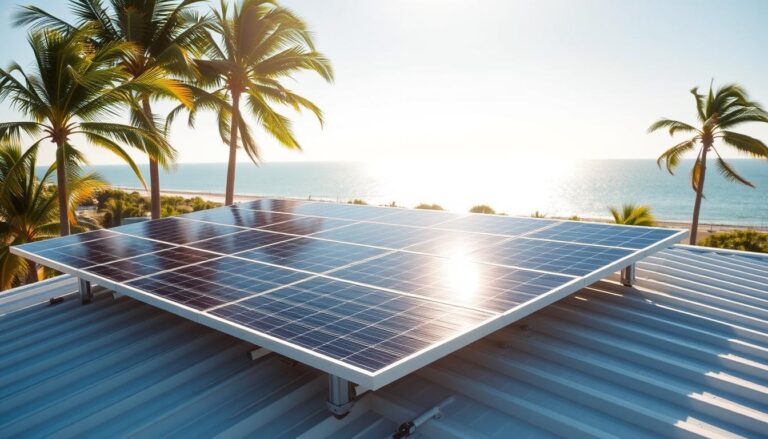
If you own a modern coastal home, condo building, or commercial property in Destin, Florida, chances are your roof isn’t the typical pitched shingle style, it’s flat or low-sloped.
While flat roofs offer clean architectural lines and easy maintenance access, they also raise common questions about solar installation:
- Can you install solar panels on a flat roof?
- How are they mounted and angled?
- Will they handle Destin’s wind and salt conditions?
Solar Cost Calculator – Florida Panhandle Only
* Estimate based on $3.25 per watt for solar installation.
* For Tesla Powerwall 3 Batteries, $15,000 for the first battery, $12,000 for each additional battery.
* Other variations and types of Batteries are available.
The answer is yes, flat-roof solar systems work extremely well in Destin when designed and installed correctly. But because coastal weather and engineering codes are tougher here than inland, it’s important to understand your options, costs, and considerations before moving forward.
Let’s explore everything you need to know about flat roof solar installation in Destin, FL, from racking systems and drainage to permitting, hurricane resilience, and ROI.
Why Flat Roofs Are Great for Solar
Contrary to popular belief, a flat roof can actually make solar installation easier in some ways.
Here’s why:
- Flexible Panel Placement – Installers can position panels at the optimal tilt and orientation (usually facing south) rather than being locked to the roof angle.
- Easy Maintenance Access – Flat roofs make cleaning and inspection safer and simpler.
- Lower Installation Complexity – No need to remove shingles or penetrate angled rafters.
- Ideal for Commercial or Modern Homes – Larger roof surface area allows for scalable systems or even solar carport add-ons.
The key difference? Mounting style. Unlike pitched roofs that use flush mounts, flat roofs rely on either ballasted or tilted racking systems to lift panels at the right angle for sunlight exposure.
Mounting Options for Flat Roof Solar Systems
1. Ballasted (Non-Penetrating) Mounts
These systems use weighted racks instead of drilling holes into your roof. Concrete blocks or ballast trays hold panels in place.
Pros:
- No roof penetrations (protects waterproof membrane).
- Fast installation.
- Ideal for single-ply or membrane roofs.
Cons:
- Heavier (requires roof load analysis).
- Not suitable for high-wind zones without extra engineering.
In Destin, where wind uplift ratings must meet ASCE 7 hurricane standards, additional anchoring or hybrid designs are often required.
2. Penetrating (Attached) Mounts
Panels are fixed directly to structural supports using watertight flashing and roof anchors.
Pros:
- More secure in hurricane-prone zones.
- Handles higher wind speeds (150+ mph).
- Lighter overall system weight.
Cons:
- Requires roof penetrations (more sealing work).
- Must be installed by experienced, licensed solar contractors.
Destin homeowners typically use attached tilt mounts for hurricane resistance while maintaining good drainage and tilt for energy production.
3. Hybrid Systems
A mix of ballast and mechanical anchors, providing both stability and wind resistance without overloading the structure.
Best for: Flat concrete roofs or multi-family structures near the shoreline.
Installer Tip: Choose a system certified for “High-Velocity Hurricane Zone” (HVHZ) ratings, even though Destin isn’t technically in South Florida’s HVHZ, Panhandle storms can produce comparable wind speeds.
Ideal Tilt Angle for Destin Solar
Flat roofs don’t automatically mean panels should be flat.
The ideal tilt angle for solar in Destin is around 15–20 degrees, which:
- Maximizes annual sunlight exposure.
- Helps rainwater and debris wash off easily.
- Prevents salt residue buildup from sea spray.
Installers can adjust the tilt using aluminum racking frames, or design multiple rows at slightly varied angles to minimize shading between panels.
Drainage and Roof Integrity
Flat roofs aren’t perfectly flat, they have a slight pitch (usually ¼ inch per foot) for drainage. When installing solar:
- Avoid blocking roof drains or scuppers.
- Ensure wiring and conduit are elevated above standing water zones.
- Use rubberized feet or walkway pads to protect the membrane from pressure points.
If your flat roof is older than 10 years, consider resurfacing or recoating it before solar installation. Solar panels will extend the roof’s life, but they shouldn’t be placed over a failing surface.
Coastal Challenges: Salt, Wind & Corrosion
Salt Air
Destin’s ocean air contains salt ions that accelerate corrosion. That’s why high-quality flat roof solar systems use marine-grade materials, such as:
- Anodized aluminum racking.
- Stainless steel bolts and clamps.
- UV-resistant wiring conduits.
A light rinse every few months helps prevent salt buildup on panels (especially for Gulf-front properties).
Wind Loads
Flat roofs catch less direct wind pressure than pitched roofs, but uplift forces can still be strong during hurricanes.
Installers must:
- Anchor racks to code (ASCE 7-16).
- Space panels to reduce wind tunneling.
- Provide PE-stamped engineering drawings for permitting.
Moisture & Mold
High humidity in the Panhandle means condensation can form under panels. Installers leave airflow gaps beneath racking to allow ventilation and faster drying.
Pro Tip: Ask your installer for wind uplift certification and corrosion warranty, especially if you’re within 2 miles of the coast.
Flat Roof Materials and Solar Compatibility
| Roof Type | Compatible? | Notes |
|---|---|---|
| TPO / PVC Membrane | ✅ Excellent | Use ballasted or hybrid systems. Avoid sharp hardware. |
| EPDM Rubber | ✅ Good | Must use compatible sealants. |
| Concrete Roof | ✅ Excellent | Allows strong mechanical anchoring. |
| Modified Bitumen (Torch Down) | ✅ Moderate | Requires careful flashing and sealing. |
| Metal Flat Roof (Standing Seam) | ✅ Excellent | Uses clamp mounts – no penetrations needed. |
Always have your installer coordinate with a roofing contractor to ensure warranty-safe installation methods.
Permitting & Local Codes in Destin
In Okaloosa County, solar permits for flat-roof systems must meet both electrical and structural standards:
- Structural engineer’s certification (PE stamp).
- ASCE 7-16 compliance (wind speed 170 mph zone).
- Product approval documentation (Florida Product Approval or UL 2703).
- Proper conduit protection against salt and moisture.
The City of Destin Building Division reviews solar permit applications electronically, and most approvals take 2–3 weeks once engineering plans are submitted.
Cost of Flat Roof Solar Systems in Destin (2025 Estimates)
| System Size | Avg. Cost (Before Incentives) | After 30% Federal Tax Credit | Annual Savings |
|---|---|---|---|
| 5 kW | $16,000–$18,000 | ~$11,200–$12,600 | $900–$1,000 |
| 7.5 kW | $21,000–$24,000 | ~$14,700–$16,800 | $1,400–$1,600 |
| 10 kW | $27,000–$30,000 | ~$18,900–$21,000 | $1,800–$2,200 |
Add 5–10% for hurricane-grade hardware or commercial-grade racking systems.
Despite slightly higher upfront costs, flat roof systems often outperform sloped installations because they’re oriented for maximum efficiency.
Maintenance & Cleaning
Flat roof panels tend to collect more dirt and water than angled ones, so regular cleaning is key to maintaining high output.
Recommended Maintenance Schedule:
- Quarterly light rinse (especially for coastal homes).
- Annual professional inspection of wiring, seals, and anchors.
- After major storms: visual check for debris, ponding, or damage.
Rain helps wash panels, but coastal residue and pollen may need manual removal. A simple rinse with deionized water or professional cleaning 2–3 times a year is ideal.
Batteries & Backup Options
Many flat-roof installations in Destin now include battery storage, especially for vacation rentals or homes prone to power outages.
Pairing your system with a Tesla Powerwall, Enphase IQ Battery, or similar device can:
- Provide nighttime power.
- Keep essentials running during outages.
- Reduce grid draw during peak hours.
Battery units can be wall-mounted in garages or mechanical rooms, not on the roof, for safety and temperature control.
ROI and Lifespan
Because Florida offers no state income tax and strong sunlight year-round, solar in Destin delivers solid returns.
Typical performance for a flat-roof system:
- Lifespan: 25–30 years.
- Annual degradation: ~0.5% per year.
- Payback period: 8–10 years.
- Lifetime savings: $30,000–$40,000+.
Plus, all Florida homeowners benefit from:
- 30% Federal Investment Tax Credit (ITC).
- Sales tax exemption on solar equipment.
- 100% property tax exemption on added value.
When Flat Roof Solar May Not Be Ideal
While flat roofs are very solar-friendly, there are a few cases where extra design work is needed:
- Shaded roofs (trees or neighboring buildings).
- Older roofs nearing replacement.
- Insufficient load-bearing capacity for ballast.
- Standing water issues or poor drainage design.
A structural evaluation and shading analysis should always be the first step before installation.
Key Takeaways
- Flat roofs are excellent candidates for solar in Destin, FL, with proper design and materials.
- Use marine-grade, hurricane-rated hardware to withstand coastal conditions.
- Choose between ballasted, attached, or hybrid mounts based on roof type and wind exposure.
- Maintain a 15–20° tilt angle for best year-round performance.
- Schedule 2–3 cleanings per year to offset salt and sand buildup.
- Expect 8–10 year payback and 25+ years of dependable energy savings.
Final Word
Destin’s sunshine and modern architecture make it a natural fit for solar, even (and especially) if your home has a flat roof.
With the right engineering, hurricane-rated materials, and maintenance plan, your solar panels can perform at peak efficiency for decades, delivering both energy independence and coastal resilience.
Whether you’re powering a beachfront home, condo building, or commercial space, flat roof solar installation in Destin, FL is a smart, sustainable investment in the Gulf Coast lifestyle.
