




Are you considering harnessing solar energy to power your home in Florida?
If so, you’re likely wondering how you can maximize your investment and reduce your utility bills. With net metering, homeowners with solar panels can send excess electricity back to the grid and receive credits on their bills.
This policy, established by the Florida Public Service Commission in 2008, is a valuable incentive for going solar. However, understanding how it works is crucial, as policies vary between utility companies. If you’re looking for expert guidance on navigating these complexities, MSM Solar LLC is here to help. Contact us at (850)737-5197 to learn more about our solar installation services.
Find Us Here:
Key Takeaways
- Net metering allows homeowners to receive credits for excess energy produced by their solar panels.
- The policy applies to Florida’s four investor-owned utilities, serving approximately 79% of residents.
- Maximizing your solar investment requires understanding the nuances of net metering policies.
- MSM Solar LLC provides expert solar installation services in the Florida Panhandle region.
- Florida’s net metering rules can significantly reduce or eliminate monthly electricity bills.
Solar Cost Calculator – Florida Panhandle Only
* Estimate based on $3.25 per watt for solar installation.
* For Tesla Powerwall 3 Batteries, $15,000 for the first battery, $12,000 for each additional battery.
* Other variations and types of Batteries are available.
What is Net Metering and Why It Matters
Understanding net metering is essential for maximizing the benefits of solar energy. Net metering is a system that allows homeowners with solar panels to generate their own electricity and export any excess to the grid. This process not only helps in reducing the energy bill but also provides a credit for the excess energy produced.
The Basic Concept of Net Metering
Net metering operates on a simple principle: it measures the difference between the amount of electricity your solar system produces and the amount of electricity you consume from the grid. When your solar system produces more electricity than you need, the excess is sent back to the grid, and you receive a credit on your electricity bill.
Financial Benefits for Solar System Owners
The financial benefits of net metering for solar system owners are substantial. By reducing your electricity bill and earning credits for excess energy, you can significantly lower your annual energy costs. Some of the key financial benefits include:
- Reducing monthly electricity bills to minimal connection fees, potentially saving thousands of dollars annually.
- Earning full retail value for the excess electricity produced by your solar system.
- Creating a bank of credits during high solar production periods to offset higher energy usage during less sunny periods.
- Achieving a payback period of approximately 7-10 years for your solar system investment, after which the system provides essentially free electricity.
- Increasing property values without raising property taxes in Florida, adding to the overall financial benefits.
By understanding and leveraging net metering, homeowners can maximize their savings and enhance the return on their solar system investment. This makes net metering a crucial aspect of making solar energy a viable and attractive option.
Net Metering in Florida: Current Policies

The Sunshine State’s approach to net metering provides a framework for solar energy adoption, balancing individual benefits with utility company interests.
Florida Public Service Commission Rules
The Florida Public Service Commission (PSC) plays a crucial role in shaping the state’s net metering policies. The PSC rules govern how utilities interact with solar system owners, ensuring a fair and transparent process for net metering.
Under these rules, utilities are required to offer net metering to customers with solar energy systems, allowing them to generate electricity and offset their consumption.
Credit Rollover and Compensation Rates
In Florida, homeowners cannot get credit for more electricity than they used from the grid in a given month, but extra credit does roll over to the next month’s bill at the full retail rate. At the end of each calendar year, any leftover credits are paid to the solar owner at a lower rate based on the utility’s wholesale energy cost—generally around 3 to 4 cents per kilowatt-hour.
Key aspects of Florida’s net metering policies include:
- Under Florida’s net metering policies, excess energy credits accumulate month-to-month at the full retail rate, allowing solar system owners to build up credits during sunny months to offset consumption during less productive periods.
- At the end of each calendar year (typically December 31st), any unused credits remaining in a customer’s account are purchased by the utility at the avoided cost rate, which is substantially lower than the retail rate at approximately 3-4 cents per kilowatt-hour.
- This annual “true-up” policy encourages solar system owners to size their installations appropriately to match their annual electricity consumption rather than significantly overproducing.
- The difference between the retail credit rate (around 12-15 cents per kWh) and the year-end compensation rate (3-4 cents per kWh) represents a significant value reduction, making it financially optimal to use all credits within the calendar year.
- Some Florida utilities have specific variations in how they handle credit rollovers and year-end compensation, so it’s essential to understand your particular utility’s policies before investing in a solar system.
Which Florida Utilities Offer Net Metering
Understanding which Florida utilities offer net metering is crucial for homeowners and businesses looking to invest in solar energy. Florida’s diverse utilities landscape offers various net metering programs, each with its unique features and benefits.
Investor-Owned Utilities
Florida’s four major investor-owned utilities (IOUs) offer net metering programs. While the specifics of these programs can vary, they generally allow customers to generate their own electricity and offset their energy consumption. The IOUs are required to follow the state’s net metering policies, which provide a standardized framework for customers.
Key benefits of IOU net metering programs include straightforward billing and the ability to carry over credits to future billing periods.
Municipal and Cooperative Utilities
In addition to IOUs, some of Florida’s municipal and rural cooperative utilities offer net metering or similar programs. For instance, Jacksonville Electric Authority (JEA) offers a “distributed generation program” that pays the fuel rate for excess generation, while also providing a battery rebate program for customers who want to store excess electricity.
- Orlando Utilities Commission (OUC) offers full-retail rate net metering.
- Lee County Electric Cooperative and Withlacoochee River Electric Cooperative offer full-retail rate net metering, with excess credits resolved at the end of the year at wholesale rates.
- Clay Electric Cooperative offers full-retail rate net metering with indefinite carryover of credits.
These municipal and cooperative utilities often have their own policies, which may differ from the state-mandated IOU programs. It’s essential for customers to check the specific policies of their utility provider to understand the benefits and limitations of their net metering program.
Understanding the Net Metering Process
To fully leverage the advantages of solar energy, it’s essential to comprehend the net metering process and its associated requirements. Net metering allows homeowners to generate their own energy and receive credits for excess production, making it a crucial component of Florida’s solar energy landscape.
System Size and Interconnection Requirements
The size of your solar system and the interconnection requirements play a significant role in determining the net metering process. Florida offers streamlined permitting and inspection for Tier 1 systems, which are typically residential solar installations under 10 kW.
- Tier 1 systems have no insurance requirement and no application fee for connecting to the electric grid.
- Tier 2 systems (10-100 kW) require an application fee ranging from $320-$400 and liability insurance coverage of up to $1 million.
Insurance and Application Fees
The costs associated with net metering, including insurance and application fees, vary depending on the size of your solar system. For most residential solar installations (Tier 1 systems), there are no application fees, making the process more accessible.
The interconnection process includes several steps: application submission, utility review, installation of appropriate metering equipment, system inspection, and final approval.
Experienced solar installation companies handle most of the paperwork and coordination with utilities on behalf of homeowners, simplifying the process.
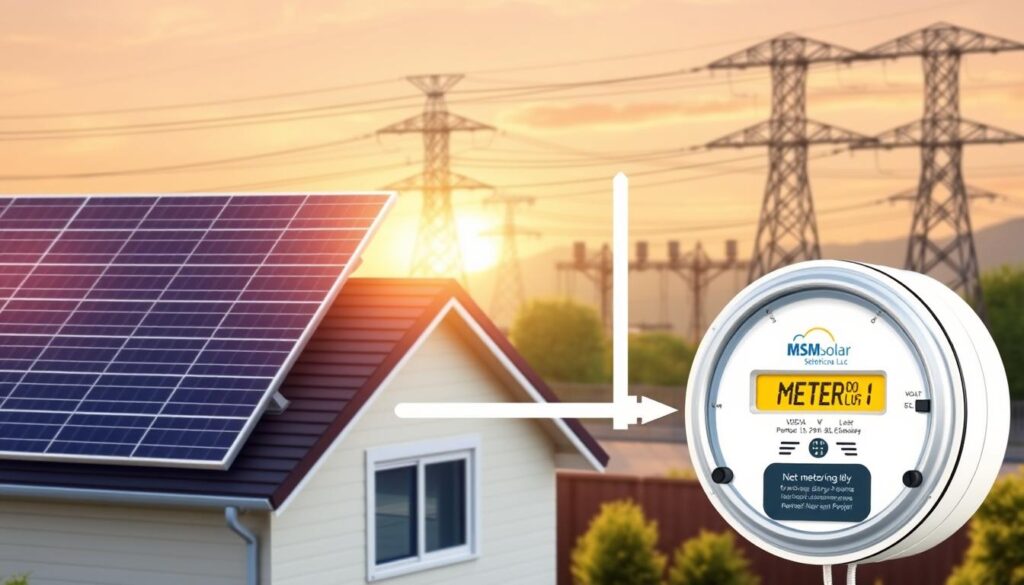
After installation, the utility will replace your standard electric meter with a bidirectional meter that can track both energy consumption and production, enabling accurate net metering calculations. This step is crucial for ensuring that you receive the correct credits for the excess energy your solar system produces.
Common Misconceptions About Net Metering in Florida

Misconceptions about net metering in Florida have sparked debate among policymakers and consumers. Net metering, a policy that allows solar system owners to generate electricity and export any excess to the grid, is often misunderstood. Despite its benefits, there are several myths surrounding this practice that need to be addressed.
The “Cost Shift” Argument
One common misconception is that net metering shifts costs from solar system owners to non-solar customers. Critics argue that as more individuals adopt solar energy, the costs of maintaining the grid are disproportionately borne by those who do not have solar systems. However, studies have shown that the benefits of net metering, including reduced energy costs and increased grid stability, outweigh the costs.
Key points to consider: The overall impact of net metering on grid costs is minimal, as solar energy production is often coincident with peak demand periods. Moreover, the gradual adoption of solar energy allows utilities to adjust their infrastructure and operations accordingly.
Grid Stability and Reliability Concerns
Another misconception is that net metering threatens grid stability and reliability. Critics argue that the intermittency of solar power can create operational challenges for utilities. However, advances in grid technology have significantly improved the ability to manage distributed energy resources.
- Modern power grids are designed to handle two-way power flows, and utilities have sophisticated tools to manage the integration of solar energy.
- Studies have demonstrated that grids can reliably accommodate high levels of solar penetration, far beyond Florida’s current level.
- Solar energy production often coincides with periods of peak electricity demand, helping to stabilize the grid during critical periods.
- Smart inverters used in modern solar installations provide grid support functions, enhancing grid stability.
The gradual adoption of solar energy in Florida allows utilities ample time to adapt, preventing sudden challenges to grid reliability.
Recent Challenges and Changes to Florida’s Net Metering
Florida’s net metering policies have faced significant challenges in recent years, driven by utility company interests. Despite the fact that customer-sited solar installations account for just 0.16% of all electricity sold in the state, lawmakers have attempted to dismantle the state’s net metering program.
Utility Company Policy Shifts
Utility companies in Florida have been pushing for changes to the net metering policy, arguing that it is not fair to non-solar customers. In 2022, Florida’s legislature passed HB741, a bill that would have gradually phased out net metering by reducing compensation rates for solar owners. However, Governor Ron DeSantis vetoed the legislation after significant public outcry.
- The vetoed bill would have reduced compensation for excess solar energy from the retail rate to the much lower “avoided cost” rate by 2029.
- Investigation revealed that Florida Power & Light actually wrote the text of the anti-net metering bill and delivered it to Senator Jennifer Bradley along with a $10,000 donation just two days later.
Legislative Attempts to Modify Net Metering
The legislative attempt to modify net metering was a significant threat to the solar industry in Florida. A survey conducted after the bill’s passage but before the veto found that 93% of Florida homeowners interested in solar would no longer consider installation if the bill became law. While this particular legislative attempt was unsuccessful, industry experts anticipate that utility companies will continue to push for changes to net metering through both regulatory and legislative channels in coming years.
Maximizing Your Benefits from Net Metering

By fine-tuning your solar system and energy habits, you can maximize your net metering benefits in Florida. To achieve this, it’s crucial to work with a qualified solar installer like MSM Solar LLC to determine the optimal size for your solar system based on your historical electricity usage.
Key Strategies for Maximizing Net Metering Benefits:
- Properly size your solar system to match 100-110% of your annual energy consumption.
- Adjust your energy usage habits to align with solar production, such as running appliances during daylight hours.
- Regularly monitor your system’s performance and net metering credits.
- Keep your solar panels clean and well-maintained to maximize energy production.
- Consider adding battery storage if your utility uses time-of-use rates.
By implementing these strategies, homeowners can significantly enhance their savings through net metering, making their solar investment even more worthwhile.
Conclusion
As utility companies and legislators challenge net metering policies, Florida homeowners must act now to secure the benefits of solar energy. Net metering remains a valuable incentive for homeowners going solar, allowing them to reduce electricity bills while contributing clean energy to the grid. To maximize benefits, understand your utility’s net metering program, including credit rates and rollover policies. MSM Solar LLC can help you navigate these complexities. Contact them at (850)737-5197 for expert guidance on solar panels and solar system installations.
FAQ
What is the current status of net metering policies for solar energy in Florida?
The current policies allow homeowners with solar panels to generate electricity and offset their energy consumption. Excess energy is credited to their utility bill at the retail rate.
How do I apply for net metering with Florida Power & Light (FPL)?
To apply, you’ll need to submit an interconnection application, provide system details, and pay any required fees. FPL will then review and approve your application.
Can I roll over credits from one month to the next with my solar system?
Yes, under FPL’s net metering program, you can roll over any excess kilowatt-hour (kWh) credits to the next billing cycle.
Are there any additional fees associated with installing a solar system and participating in net metering?
You may need to pay interconnection fees, inspection fees, or other costs associated with installing your solar system. However, some utilities offer incentives to offset these costs.
How do utilities in Florida compensate solar customers for excess energy production?
Utilities like FPL compensate solar customers by crediting their accounts at the retail rate for excess energy produced.
What are the system size limits for net metering in Florida?
The system size limit varies depending on the utility and the type of customer. Typically, residential systems are limited to 10-20 kilowatts (kW).
Can I sell my excess energy back to the grid at a higher rate than the retail rate?
No, under current policies, excess energy is credited at the retail rate, not at a higher rate.
How do I maximize my savings with net metering and solar energy?
To maximize savings, optimize your solar system’s size and configuration, and adjust your energy usage patterns to minimize consumption during peak hours.
