



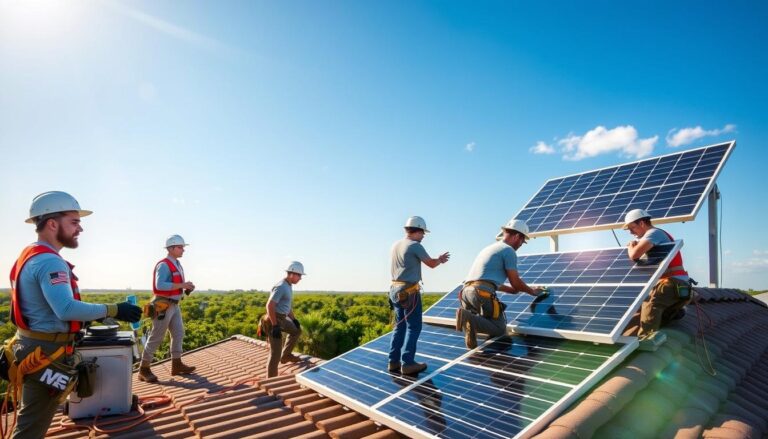
Understanding the Value of Live Oaks in Navarre
Navarre’s coastal landscape is dotted with majestic live oaks that have stood for generations, providing shade, wildlife habitat, and a sense of place. Homeowners often face a dilemma when considering solar installations: how to capture clean energy without sacrificing these beloved trees. The answer lies in a thoughtful approach that blends modern solar technology with the natural canopy, creating a harmonious coexistence.
Solar Cost Calculator – Florida Panhandle Only
* Estimate based on $3.25 per watt for solar installation.
* For Tesla Powerwall 3 Batteries, $15,000 for the first battery, $12,000 for each additional battery.
* Other variations and types of Batteries are available.
What Makes a Solar Layout Shade Tolerant?
A shade‑tolerant solar layout is designed to function efficiently even when panels receive less direct sunlight than a fully exposed array. This involves selecting high‑efficiency panels that perform well under diffuse light, positioning arrays to capture the most sunflecks that filter through the leaves, and using micro‑inverters or power optimisers that maximise output from each panel individually.
When you pair these technologies with strategic stringing—running panels in shorter, flexible strings—you reduce the impact of shading on overall system performance. The result is a solar installation that respects the live oak canopy while still delivering a meaningful reduction in household electricity consumption.
Key Components of a Shade Tolerant System
- High‑efficiency monocrystalline panels with low temperature coefficients.
- Power optimisers or micro‑inverters for panel‑level monitoring.
- Short, parallel strings to limit voltage drop from shaded panels.
- Adjustable mounting racks that allow tilt and orientation tweaks.
Assessing Your Property: The First Step
Before any equipment is ordered, conduct a thorough site assessment. Measure the canopy spread of each live oak, note the direction of predominant afternoon shade, and calculate the sun‑hours the site receives on a typical clear day. Solar designers often use a solar pathfinder or a simple smartphone app to map shading patterns throughout the year.
In Navarre, live oaks commonly grow to a canopy radius of 30‑40 feet, casting a broad shadow that can shift with seasonal leaf density. By mapping these shadows, you can identify zones where panels can be placed with minimal obstruction, often along the property’s north‑south axis where the sun’s angle is most favourable.
Tools for Accurate Shade Mapping
- Solar Pathfinder 2.0 – a handheld device that visualises shading over a grid.
- Helioscope or Aurora Solar – software platforms that simulate shading over time.
- Simple shadow‑tracing with a chalk line on the ground during peak sun hours.
Designing the Shade Tolerant Solar Layout Live Oaks Navarre Style
Now that you have a clear picture of the canopy, it’s time to translate those insights into a practical layout. The goal is to keep the live oaks standing, minimise pruning, and still achieve a respectable kilowatt‑hour (kWh) offset. Below is a step‑by‑step guide tailored for Navarre homeowners.
Step 1 – Choose the Right Panel Model
Look for panels that retain at least 85 % of their rated output when receiving 50 % shading. Brands that advertise “shade‑tolerant” or “low‑irradiance” performance are ideal for the live oak environment.
Step 2 – Determine Array Orientation
In most Navarre neighborhoods, a south‑facing orientation captures the most sunlight. However, when live oaks dominate the southern façade, a southeast or southwest tilt can harvest more sunflecks while keeping panels out of the deepest shadows.
Step 3 – Use Power Optimisers
Installing optimisers on each panel allows the system to bypass shaded cells, ensuring that the rest of the array continues to operate at peak efficiency. This technology is the backbone of any shade tolerant solar layout live oaks navarre project.
Step 4 – Create Short Parallel Strings
Instead of a long series string, break the system into multiple short strings (e.g., 5‑6 panels per string). This reduces the voltage impact of any shaded panel and simplifies troubleshooting.
Step 5 – Mount Panels on Adjustable Racks
Adjustable racks let you raise or lower panels seasonally, adapting to leaf density changes. In summer, a slight increase in tilt can capture higher sun angles, while in winter, a flatter angle maximises low‑sun exposure.
Selective Pruning: When Is It Necessary?
Pruning should always be a last resort. Live oaks are protected in many Florida municipalities, and excessive limb removal can stress the tree and diminish its ecological benefits. However, strategic, minimal pruning—such as removing lower, dead branches that do not contribute to the canopy’s health—can create a small opening for sunlight without compromising the tree’s structural integrity.
Consult a certified arborist before any cuts. They can assess whether a branch is truly detrimental or simply part of the tree’s natural form. In most cases, a modest 10‑15 % canopy reduction around the solar array is sufficient to improve performance while keeping the tree thriving.
Financial Benefits: Saving kWh and Dollars
Even with partial shading, a well‑engineered shade tolerant solar layout can offset 30‑40 % of a typical Navarre home’s electricity use. Over a 25‑year system life, this translates to thousands of kilowatt‑hours saved and a substantial reduction in utility bills.
Moreover, Florida’s net‑metering policies allow you to feed excess generation back to the grid, earning credits that further improve your return on investment. When you factor in federal and state incentives, the payback period for a shade‑friendly system often falls within 7‑9 years.
Case Study: The Miller Residence on Gulf Shore Drive
The Miller family wanted solar power but was reluctant to sacrifice their 80‑year‑old live oak that shades their backyard patio. After a detailed shade analysis, they installed a 6 kW system using high‑efficiency panels, power optimisers, and four parallel strings positioned to the east of the oak.
Selective pruning removed only two low‑hanging branches that interfered with the lowest panel row. The result? The system now produces an average of 8,500 kWh per year, offsetting roughly 35 % of the household’s consumption while the oak remains healthy and vibrant.
Maintenance Tips for Long‑Term Success
- Inspect optimisers and micro‑inverters annually for dust or debris.
- Trim any new growth that begins to shade panels, using an arborist’s guidance.
- Monitor system performance via the installer’s portal; a sudden dip may indicate new shading.
- Schedule a professional cleaning of panels every 2‑3 years to maintain efficiency.
Quick Reference: Shade Tolerant Solar Layout Live Oaks Navarre Checklist
| Item | Action |
|---|---|
| Site Assessment | Map canopy, record sun‑hours, use shading tools. |
| Panel Selection | Choose high‑efficiency, shade‑tolerant modules. |
| Power Optimisers | Install on each panel for module‑level MPPT. |
| String Design | Use short parallel strings (5‑6 panels each). |
| Mounting | Adjustable racks for seasonal tilt changes. |
| Pruning | Only minimal, arborist‑approved cuts if needed. |
Future Trends: Smarter Systems for Shaded Environments
Advances in artificial intelligence and machine learning are enabling solar inverters to predict shading patterns and adjust output in real time. Future installations in Navarre may incorporate sensors that detect leaf density and automatically tilt panels for optimal exposure, further enhancing the shade tolerant solar layout live oaks navarre concept.
In addition, bifacial panels—those that capture light on both sides—are gaining popularity. When installed above a reflective ground surface, they can harvest reflected sunlight that filters through the oak canopy, offering another layer of efficiency without compromising the tree.
Getting Started: Your Path to a Greener Navarre Home
Embarking on a shade‑friendly solar project begins with a conversation. Reach out to a certified solar installer familiar with Navarre’s unique environment and request a free shade analysis. Ask specifically about a shade tolerant solar layout live oaks navarre design, and ensure they propose power optimisers and adjustable mounting as standard components.
Remember, preserving your live oak while generating clean energy is not only possible—it’s a win‑win for the planet, your wallet, and the character of your neighbourhood. With careful planning, modern technology, and respect for the natural canopy, you can keep the tree, save the kWh, and enjoy the best of both worlds.
Conclusion
By integrating shade‑tolerant technologies, strategic stringing, and minimal, expert‑guided pruning, Navarre homeowners can install solar systems that honour the legacy of live oaks while delivering meaningful energy savings. Embrace the shade tolerant solar layout live oaks navarre approach and join the growing community of eco‑conscious residents protecting both trees and the grid.
