



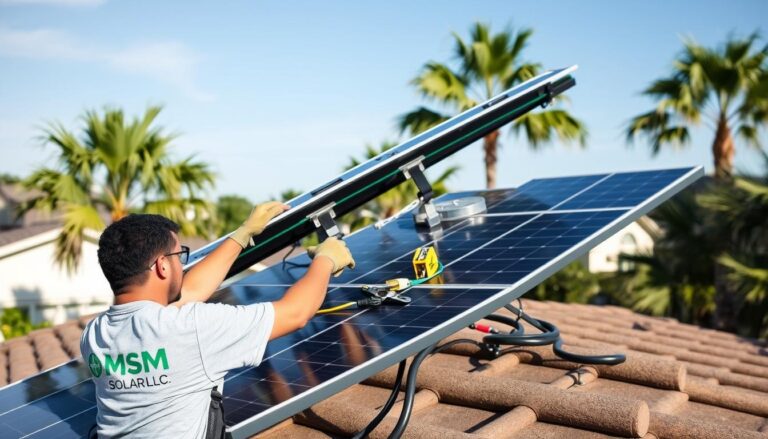
As the days get shorter and the sun hangs lower in the sky, many homeowners across Northwest Florida, from Pensacola and Destin to Panama City and Tallahassee, wonder whether they should adjust their solar panel tilt for the winter months.
The idea makes sense: if the sun’s angle changes, maybe your panels should too. But is re-angling your system really worth the effort (and cost) in Florida’s mild winters?
Let’s dig into how seasonal tilt affects solar production, how much extra energy you can gain, and whether manual or adjustable mounts make sense in the Florida Panhandle’s sunny-yet-subtropical climate.
Solar Cost Calculator – Florida Panhandle Only
* Estimate based on $3.25 per watt for solar installation.
* For Tesla Powerwall 3 Batteries, $15,000 for the first battery, $12,000 for each additional battery.
* Other variations and types of Batteries are available.
Understanding Solar Tilt Basics
Solar tilt refers to the angle at which panels are mounted relative to the ground (or roof). The tilt determines how directly sunlight hits the panels throughout the day.
In an ideal setup, the panels are positioned perpendicular to the sun’s rays to capture maximum energy. But because the sun’s path shifts between summer and winter, the optimal tilt angle changes seasonally:
- Summer: The sun is higher in the sky → shallower panel angle (flatter).
- Winter: The sun is lower → steeper panel angle (more upright).
In places with large seasonal sun-angle swings, like northern states, this adjustment can lead to substantial production gains.
But in Northwest Florida, where the difference is smaller, the payoff may not justify the hassle.
The Sun’s Path in Northwest Florida
Let’s look at how sunlight shifts throughout the year in this region.
| Month | Solar Elevation (Noon) | Optimal Fixed Tilt (°) | Average Daily Sun Hours |
|---|---|---|---|
| June | ~83° | 25–30° | 5.9–6.1 hrs |
| December | ~36° | 50–55° | 4.5–4.7 hrs |
At 30°N latitude, Northwest Florida experiences about a 47° difference in solar altitude between June and December. That means winter sunlight arrives at a lower angle, producing longer shadows and slightly less daily energy.
However, Florida’s overall irradiance (sunlight strength) remains high, even in December, you’ll see more sunshine than most U.S. regions get in summer.
Fixed vs. Adjustable Tilt Systems
Most residential solar systems in Florida are installed on fixed-tilt roof mounts. This is because:
- Roof slope (usually 20–30°) already aligns reasonably well with Florida’s latitude.
- Fixed systems have lower installation costs and fewer moving parts.
- Florida’s relatively consistent sunlight reduces the need for tilt adjustments.
That said, some ground-mounted or flat-roof arrays in Northwest Florida use adjustable racking systems, allowing owners to change tilt seasonally, usually twice a year (summer vs. winter).
Theoretical Energy Gain from Winter Tilt Adjustment
Let’s crunch the numbers.
Assume a 7.5 kW system in Pensacola, installed at a fixed 25° tilt (typical roof pitch).
Annual Solar Production (Estimated via PVWatts):
- Fixed 25° tilt: 11,200 kWh/year
- Adjusted to 50° tilt in winter (Dec–Feb): 11,380 kWh/year
That’s an annual gain of ~1.6%, or ~180 kWh per year, roughly $25–$30 in savings at current utility rates.
For a system designed for decades of low maintenance, the modest gain rarely offsets the labor, equipment wear, and risk of climbing onto the roof to change panel angles.
Bottom Line: In Northwest Florida, adjusting tilt manually adds marginal efficiency but little financial benefit.
When Winter Tilt Adjustments Might Make Sense
There are specific cases where steeper winter tilt angles are worth considering:
1. Ground-Mount or Pole-Mount Systems
If your panels are mounted on the ground or on a tracking pole, adjusting tilt is simple and safe. In that case, increasing the angle to 45–50° during winter can yield 3–5% more production.
2. Off-Grid or Battery-Based Homes
If you rely on solar power year-round, especially off-grid, every extra kWh counts. Adjusting tilt in December and February helps maximize charge levels during shorter daylight hours.
3. Shady Roofs or Tall Surrounding Trees
If shading reduces your solar hours in winter, increasing the panel angle can sometimes capture more direct midday sunlight, improving performance slightly.
For most grid-tied homes, however, fixed tilt remains the most cost-effective and safest approach.
Optimal Tilt Angles for Northwest Florida
If you’re planning or adjusting your system, here’s a general guide for year-round solar optimization in the Florida Panhandle:
| Application | Recommended Tilt | Seasonal Option | Notes |
|---|---|---|---|
| Fixed Roof Mount | 25–30° | N/A | Ideal for most homes; matches roof slope. |
| Ground Mount (Year-Round) | 30° | 20° Summer / 45° Winter | Best all-season compromise. |
| Off-Grid / High Battery Use | 35–40° | Steeper winter tilt helps maintain battery health. | |
| Flat Roof Mount | 10–15° | N/A | Minimal tilt needed for drainage and sun exposure. |
Pro Tip: A tilt close to your latitude (≈30°) gives the best balance between summer and winter performance for Northwest Florida.
The Role of Solar Trackers
Some premium solar installations use single-axis or dual-axis tracking systems, which automatically adjust panel tilt and orientation to follow the sun.
In Florida, where utility rates are moderate and weather mild, trackers rarely provide strong ROI for residential users.
- Single-axis trackers: Boost production by ~10–15% annually.
- Dual-axis trackers: Up to 25–30% more output, but at 2–3x higher cost.
These systems are better suited for commercial or utility-scale arrays where land is abundant, and long-term output gains justify the investment.
The Real Winter Challenge: Shading and Soiling
While tilt adjustments provide minimal gains, shade and cleanliness matter much more during Florida’s winter months.
1. Longer Shadows
Winter’s lower sun angle means trees, chimneys, and even neighboring houses cast longer shadows. If your array experiences partial shading:
- Prune trees before late fall.
- Use microinverters or power optimizers to reduce shading losses.
2. Salt and Pollen Build-Up
In coastal towns like Destin, Miramar Beach, and Panama City Beach, salt mist from the Gulf can cling to panels. Meanwhile, pine pollen in early spring can coat surfaces and block sunlight.
Light cleaning with soft water and a microfiber mop every few months can restore up to 5% of lost performance, far more than tilt adjustments alone.
Pro Tip: Schedule a quick cleaning after heavy storms or extended dry spells to maintain optimal winter performance.
Why Winter Solar Still Performs Well in Northwest Florida
Despite cooler temperatures and lower sun angles, Florida’s winter conditions are actually great for solar production.
- Cooler air = higher panel efficiency. Solar modules operate best at 50–75°F, typical for Panhandle winters.
- Less cloud cover than in summer. Winter skies are clearer, boosting consistent sunlight hours.
- Lower household loads. Heating needs are minimal, so you export more energy to the grid.
That means even without tilt adjustments, your system’s winter production often meets or exceeds expectations.
Safety and Warranty Considerations
Before attempting any tilt adjustments, it’s crucial to understand potential risks:
- Warranty voids: Modifying racking angles without manufacturer approval can void warranties.
- Roof damage: Frequent re-angling stresses mounts and sealants.
- Personal safety: Climbing on roofs for manual adjustment isn’t worth the minimal gains.
If you’re determined to experiment with seasonal tilting, hire a licensed solar contractor who can verify load limits, torque specs, and waterproofing integrity.
A Smarter Alternative: Virtual “Tilt Optimization”
Instead of physically adjusting panels, many modern systems use software-based optimization:
- AI-powered monitoring apps (like Enphase Enlighten or SolarEdge mySolarEdge) analyze panel-level data and weather patterns.
- They help predict production variances and guide homeowners to maximize ROI without manual changes.
You can use these insights to adjust your energy habits instead, such as:
- Running laundry or pool pumps during peak daylight hours.
- Pre-cooling your home in the afternoon.
- Charging EVs during mid-day solar peaks.
Small behavioral shifts yield more real savings than any physical tilt tweak.
Example ROI Comparison
| Strategy | Estimated Annual Gain | Cost | Effort | ROI |
|---|---|---|---|---|
| Adjust tilt seasonally | 1–2% | $0 (DIY) | Moderate | Minimal |
| Clean panels twice a year | 3–5% | $100–$200 | Low | Strong |
| Trim shading trees | 3–10% | $100–$300 | Moderate | Excellent |
| Add microinverters | 5–12% | Varies | One-time | High |
| Upgrade to tracker | 15–25% | $5K–$10K | Medium | Low for residential |
Takeaway: Routine maintenance and smart design choices beat manual tilt changes every time.
Winter Energy Planning Tips for Solar Homes
- Monitor output monthly to understand seasonal performance patterns.
- Compare December–February production to summer months, expect 10–20% less output, which is normal.
- Check inverter alerts for any shading or string issues after storms.
- Schedule inspections annually to ensure mounts remain tight and corrosion-free.
- Keep trees trimmed and panels clean, your best “tilt” is a clear, sunny panel surface.
Key Takeaways
- Florida’s winter sunlight remains strong, making tilt changes unnecessary for most homeowners.
- Adjusting tilt yields only 1–2% efficiency gains, not worth the risk or effort on roof-mounted systems.
- Focus on panel cleaning, shade management, and smart monitoring for higher returns.
- For ground-mounted or off-grid setups, modest seasonal tilt adjustments (to 45–50°) can help.
Final Word
For most homeowners in Northwest Florida, adjusting solar panel tilt in winter is more a matter of curiosity than necessity. The region’s latitude, mild weather, and abundant sunshine mean your panels already perform efficiently year-round.
Instead of re-angling panels, your time is better spent keeping them clean, trimming nearby trees, and using monitoring tools to stay proactive.
With smart care and design, your solar array will capture every ray the Gulf Coast sky has to offer, no wrench required.
