



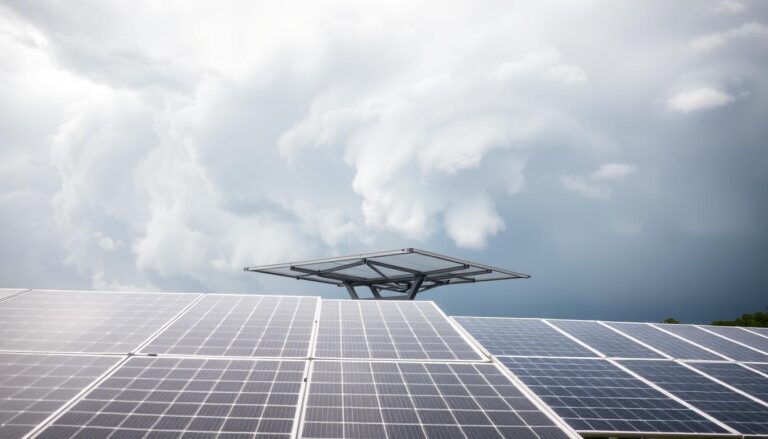
When most people picture Florida, they imagine endless sunshine. But in the Florida Panhandle, winter brings shorter days, lower sun angles, and more cloud cover. For solar homeowners, this seasonal shift can raise questions: How much energy will my system produce in winter? Should I adjust tilt? How can I track performance?
This guide dives into winter solar in the Florida Panhandle, with tips on monthly kWh expectations, shade mapping, and DIY monitoring so your array stays productive from December through February.
Also Read: Solar for Small Businesses on the Emerald Coast: Demand Charges & Peak-Shaving with Batteries
Solar Cost Calculator – Florida Panhandle Only
* Estimate based on $3.25 per watt for solar installation.
* For Tesla Powerwall 3 Batteries, $15,000 for the first battery, $12,000 for each additional battery.
* Other variations and types of Batteries are available.
How Winter Affects Solar Output in the Panhandle
- Shorter days: Around the December solstice, daylight lasts only ~10.2 hours in Pensacola vs. ~14 hours in June.
- Lower sun angle: The sun rises and sets further south, staying lower in the sky. This reduces panel efficiency unless tilt is optimised.
- Weather patterns: The Panhandle sees more overcast days and frontal systems in winter, further trimming production.
Expect 20–35% less solar output in winter months compared to summer highs.
Monthly kWh Expectations: December–February
Here’s a rough guide for a 7 kW residential system in Escambia, Okaloosa, or Bay County:
- December: ~650–750 kWh
- January: ~700–800 kWh
- February: ~850–950 kWh
Compare this to 1,000–1,100 kWh in June/July, and you’ll see the seasonal dip. Systems closer to the coast (with clearer horizons) may perform slightly better than shaded inland properties.
Rule of thumb: expect winter production to cover 60–70% of your summer monthly output.
Tilt Adjustments for Winter
Most rooftop solar arrays in the Panhandle are fixed at the roof pitch (often 20–30°). But if you have an adjustable ground mount or pergola system, tilt changes can squeeze out extra kWh.
- Optimal year-round tilt: ~25–28° (close to local latitude).
- Winter tilt (Dec–Feb): ~35–40° for higher sun capture.
- Summer tilt (May–Aug): ~15–20° for stronger midday production.
For most homeowners, roof-fixed arrays still perform well year-round. But rural or off-grid setups with adjustable racks can benefit from 5–10% extra winter production by tilting steeper.
Shade Mapping in Winter
Winter shading looks different than summer shading. Because the sun is lower, tall trees, chimneys, and nearby structures may cast longer shadows.
How to check:
- Use apps like Solar Pathfinder or PVWatts to simulate shading by month.
- On a sunny December afternoon, physically walk around your array and note where shadows fall.
- Pay special attention to south-facing obstructions, even partial shading can drag down entire panel strings.
If shade is unavoidable, consider module-level optimisers (MLPs) like Enphase microinverters or SolarEdge optimisers, which reduce losses when only one panel is shaded.
DIY Monitoring Goals for Winter
Your monitoring app (Enphase Enlighten, SolarEdge, or similar) is your best tool for spotting issues in winter.
Set these DIY monitoring goals:
- Daily check: Ensure production follows a “bell curve” shape. Flat or jagged graphs may signal faults or shading.
- Monthly comparison: Track December–February production against installer estimates.
- Alert settings: Enable email/push notifications for panel or inverter errors.
- Weather tracking: Compare cloudy-day output vs. sunny-day output to set realistic expectations.
Pro tip: Take screenshots at the start of December and February. Comparing year-over-year helps you see if output is slipping due to new shading or dirt buildup.
Cleaning & Maintenance in Winter
The Panhandle doesn’t see snow buildup, but pollen, leaves, and bird droppings can still reduce output. Winter is a great time to:
- Rinse panels with a hose on mild mornings.
- Trim branches casting long winter shadows.
- Inspect rails and flashings after fall storms.
Since demand is lower in many households during winter (less A/C use), the seasonal dip usually balances out financially.
Case Study: Homeowner in Santa Rosa County
- System size: 8.2 kW rooftop solar
- December output: 720 kWh
- January output: 780 kWh
- February output: 890 kWh
- Summer peak (July): 1,090 kWh
By adjusting tilt to 35° on a pergola system and trimming oak trees to the south, the homeowner gained ~8% more winter kWh compared to the previous year.
Long-Term Perspective
Solar is designed with seasonal variation in mind. Even if winter months show lower production, your annual performance will average out:
- Annual kWh per kW installed: ~1,450–1,600 in the Panhandle.
- Winter share (Dec–Feb): ~18–20% of annual total.
- Summer share (May–Aug): ~35–40% of annual total.
That balance is already factored into your installer’s ROI projections.
Key Takeaways
- Winter solar in the Florida Panhandle delivers ~60–70% of summer output.
- Expect ~650–950 kWh/month for a 7 kW system during Dec–Feb.
- Adjustable tilt can boost winter production by 5–10%.
- Shade mapping is critical since low sun angles cast long shadows.
- DIY monitoring helps you spot issues before they cost you kWh.
Final Word
Florida’s Panhandle may be sunny, but winter does impact production. By tweaking tilt, mapping shade, and monitoring output, you’ll maximise performance during December–February. With these simple steps, your system stays reliable, efficient, and resilient, rain or shine.
