

An AC not cooling on a July afternoon in Fort Walton Beach or Marianna is an emergency of its own kind. Before you pay for a service call, there are several checks any homeowner can do safely in about fifteen minutes. A surprising number of no-cooling calls end with a five-dollar filter or a tripped switch. This list starts with the simple causes and works up to the ones that need a technician.
Solar Cost Calculator – Florida Panhandle Only
* Estimate based on $3.25 per watt for solar installation.
* For Tesla Powerwall 3 Batteries, $15,000 for the first battery, $12,000 for each additional battery.
* Other variations and types of Batteries are available.
1. Check the thermostat first
Make sure it is set to Cool, the fan is on Auto, and the set temperature is below the room temperature. If the screen is blank, replace the batteries. If someone has switched the fan to On, the system will blow air all day whether or not it is cooling, which feels like a fault but is not one.
2. Replace the air filter
A clogged filter is the most common cause of weak cooling. It starves the system of air, the indoor coil gets too cold and ices over, and airflow drops to almost nothing. Hold the filter up to the light. If you cannot see through it, replace it. In a Panhandle summer, monthly changes are sensible, more often with pets or building work nearby.
3. Look for ice
Open the air handler door or look at the copper line where it enters the indoor unit. Frost or ice means the system has frozen. Switch cooling off, set the fan to On for two to three hours to melt it, fit a clean filter, and try again. If it freezes a second time, the cause is likely low refrigerant or a blower problem, and you need a technician.
4. Check the breakers and the outdoor disconnect
Your system has two breakers, one for the indoor air handler and one for the outdoor unit. If the fan indoors is running but the air is warm, the outdoor breaker may have tripped. Reset it once. If it trips again, leave it off and call for service, because a breaker that keeps tripping is protecting you from something.
5. Clear the condensate drain
Florida air conditioners pull gallons of water out of the air every day. That water leaves through a small drain pipe, which algae loves to block. Most systems have a float switch that shuts the cooling off when the pan fills, to prevent a flooded ceiling. If you see water in the pan under the air handler, the drain is blocked. A wet vacuum on the outside end of the pipe often clears it. Pouring a cup of white vinegar into the drain line every month or two helps keep it clear.
6. Look at the outdoor unit
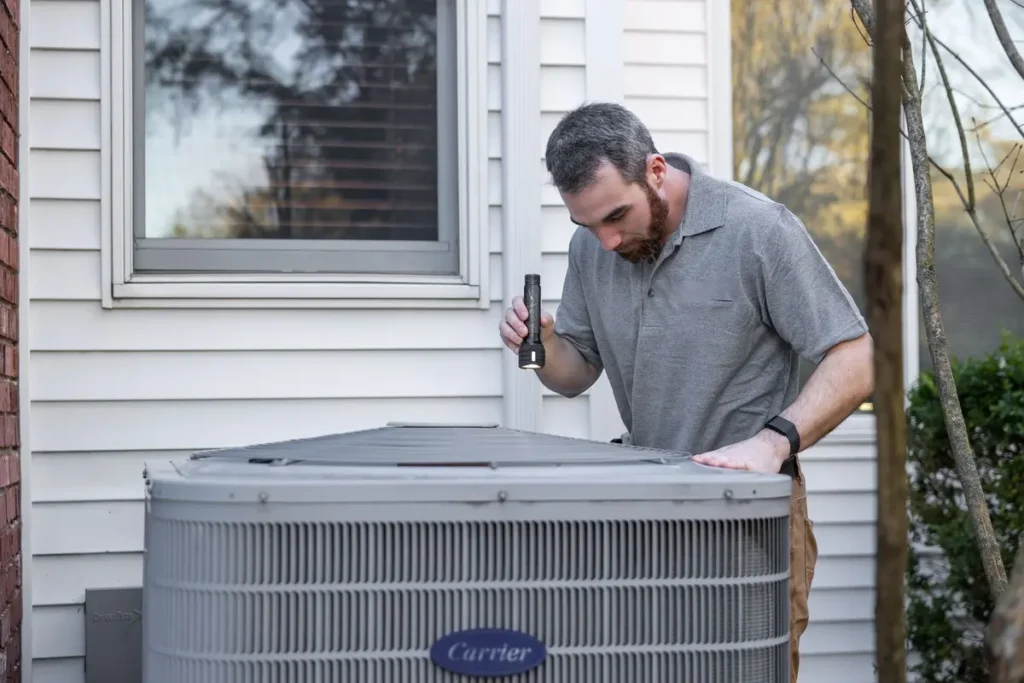
The outdoor unit gets rid of the heat taken from your house. It cannot do that if it is wrapped in leaves, grass clippings or vines. Switch the power off at the disconnect, clear at least two feet of space around it, and rinse the fins gently with a garden hose from the top down. Do not use a pressure washer. If the fan on top is not spinning while the unit hums, switch it off and call a technician. That is usually a failed capacitor, a common and fairly inexpensive repair in our heat.
7. Check the vents and doors
Closed or blocked supply vents and a blocked return grille reduce airflow across the coil. Open every vent, move furniture away from returns, and keep interior doors open when possible. Closing vents in unused rooms does not save money and can cause icing.
8. Compare supply and return temperatures
Hold a kitchen thermometer in a supply vent and then at the return grille. A healthy system usually delivers air roughly 15 to 20 degrees cooler than the air it takes in. If the difference is much smaller, the system is running but not removing heat, which points to refrigerant, a compressor issue or leaking ducts.
When it is working but cannot keep up
Sometimes nothing is broken. On the hottest afternoons, a correctly sized system may run continuously and hold the house a few degrees above the setting. That is normal. What is not normal is a system that used to keep up and no longer does. Common reasons are ducts that have come apart in the attic, insulation that has thinned, or an ageing unit that has lost capacity.
When to call a professional
- Ice returns after you have thawed the system and changed the filter.
- A breaker trips more than once.
- The outdoor fan or compressor will not start.
- You hear grinding, screeching or loud buzzing.
- There is a burning smell or visible damage to wiring.
- The system is more than 12 to 15 years old and repairs are becoming frequent.
The bill behind the problem
An air conditioner that is struggling uses more electricity than one in good health, so a cooling fault often shows up on the power bill before it shows up as discomfort. Our article on the hidden cost of leaving an older HVAC system in place covers that in detail. Once the system is healthy, the next question is how to pay less for the power it uses. Air conditioning demand lines up closely with solar production, which makes cooling-heavy homes in Fort Walton Beach, Marianna and Pensacola good candidates for a new solar installation. See also how HVAC and other large loads affect solar sizing.
Frequently asked questions
Why is my AC running but not cooling the house?
The usual causes are a dirty filter, a frozen coil, a tripped outdoor breaker, a blocked outdoor unit or low refrigerant. Work through them in that order.
How often should I change my AC filter in Florida?
Every month in summer for standard one-inch filters. Thicker media filters last longer; follow the maker's guidance.
Can I add refrigerant myself?
No. Refrigerant handling requires certification, and a system that is low has a leak that needs to be found and repaired.
How long should an air conditioner last in Florida?
Often 10 to 15 years. Salt air near the coast and long run hours shorten that, and regular maintenance extends it.
Conclusion
When the AC is not cooling, check the thermostat, filter, ice, breakers, drain and outdoor unit before calling anyone. Those six checks solve a large share of problems and cost almost nothing. If the fault is electrical, involves refrigerant or keeps coming back, call a licensed HVAC technician.
MSM Solar works with homeowners in Quincy, Rosemary Beach, Seaside, St. George Island and Alford, and in every town between Pensacola and Apalachicola.
And if the system works but your summer bills do not, we can help with that part. Call MSM Solar at (850) 737-5197 or request a free quote, and we will call you back no later than two business days.