
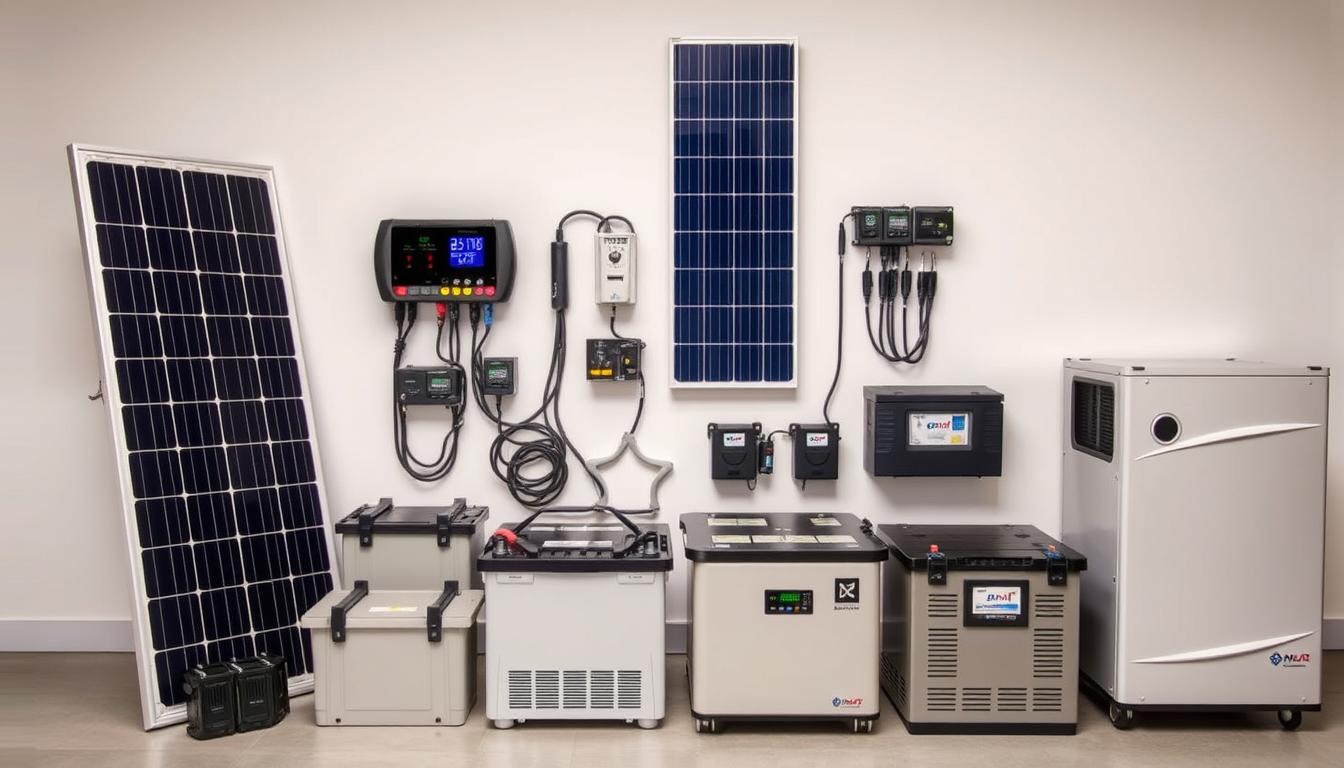
Solar inverters usually wear out long before the panels do, so many Florida Panhandle homeowners will replace one at some point. When an older inverter fails, you can usually swap in a compatible like-for-like model, upgrade to a newer string or hybrid inverter that can work with a battery, or move to microinverters or optimizers. The right choice depends on your panels, your wiring, local code and your plans for battery backup.
Why inverters fail before solar panels
Solar panels have no moving parts and are built to sit in the sun for decades. The inverter is different. It is the electronic device that converts the direct current (DC) your panels produce into the alternating current (AC) your home and the grid use. Inside are capacitors, circuit boards, relays and often cooling fans, and those parts age, especially with heat.
That is why string inverters typically carry shorter manufacturer warranties than the panels they serve. In the Panhandle, an inverter mounted on a west-facing wall in full afternoon sun, in a hot garage, or close to salt air near the coast has a tougher life than one installed in a shaded, ventilated spot. Lightning surges and storm-related power events can also damage inverter electronics.
Signs your inverter may need replacing
- No production at all on a sunny day, with the inverter screen dark or showing a persistent fault.
- Repeated error codes that come back after a restart, or a fault that the manufacturer lists as a hardware failure.
- Production that keeps dropping compared with the same month in earlier years, when the panels are clean and unshaded.
- Clicking, buzzing or a fan that runs constantly and sounds different than it used to.
- Visible damage such as burn marks, corrosion, water inside the enclosure or a swollen case.
- Monitoring that has gone silent. Sometimes this is only a Wi-Fi or account issue, but it can also mean the inverter has stopped.
Before assuming the worst, check the simple things: a tripped solar breaker, an AC disconnect that was switched off, or a recent power outage. If you are not sure what an error light means, our guide to solar inverter error lights walks through the basic checks. Do not open the inverter or touch the DC wiring; the panels keep producing voltage whenever the sun is out.
Repair or replace?
Some inverter problems are fixable: a failed communication card, a blown fuse, a loose connection, a firmware issue or a faulty fan. If the inverter is still under the manufacturer's warranty, the manufacturer may repair or replace it, though labor may not be included. Keep your original paperwork, serial numbers and installation date handy, since you will need them for a claim.
When the inverter is out of warranty, the model has been discontinued, or the same unit has failed more than once, replacement usually makes more sense than another repair. A technician who tests the system can tell you whether the fault is in the inverter itself or somewhere else, such as a damaged panel connector or a string with a ground fault. Replacing an inverter will not fix a wiring problem upstream of it.
Your replacement options
There are four common paths, and not every one fits every system:
- Like-for-like string inverter. A new inverter of similar size from the same or another manufacturer. This is usually the simplest swap, as long as the new unit's voltage and current ratings fit your existing panel strings.
- Hybrid inverter. An inverter designed to work with a home battery now or later. If you have been thinking about backup power for hurricane season, replacing a failed inverter is a natural time to consider this.
- Microinverters. A small inverter under each panel instead of one central unit. This adds work on the roof, but it removes the single point of failure and allows panel-by-panel monitoring.
- Power optimizers with a compatible inverter. Devices at each panel that work with a central inverter. They help with shading and can provide module-level shutdown.
The choice depends on the age and condition of your panels, how much shade the roof gets, whether your current setup meets today's rapid shutdown rules, and whether you want battery backup. If your panels are near the end of their life too, it may be worth comparing an inverter swap with a larger system upgrade.
Compatibility, code and utility paperwork
A replacement inverter has to match the electrical characteristics of your existing panels and strings. If the new unit's input voltage window is different, the strings may need to be reconfigured. A good installer checks this before ordering equipment.
Code matters too. Electrical codes have changed since many older Panhandle systems were installed, particularly around rapid shutdown of rooftop wiring. Depending on the scope of the work and the local building department, replacing an inverter can require a permit and may require bringing parts of the system up to current code. Your utility may also need updated interconnection paperwork if the inverter make or size changes. FPL, which now serves the former Gulf Power territory, and the local co-ops such as CHELCO, Gulf Coast Electric and West Florida Electric each have their own interconnection process, so ask your installer to handle or confirm that step.
Orphaned systems and old equipment
Many homeowners discover that the company that installed their system has closed, or the inverter brand is no longer sold. That is common and does not mean the system is a loss. MSM Solar services systems of any brand and age, including orphaned systems whose original installer is gone. We can test the panels and wiring, identify a compatible replacement, and handle the swap. Learn more about our solar service calls, where pricing is quoted up front before work begins.
We serve homeowners across the region, including Fort Walton Beach, Milton and Panama City.
Costs, taxes and what to budget for
Inverter replacement cost varies with the type of inverter, the system size, whether strings need rewiring, and whether code upgrades or a permit are required. Moving to microinverters or optimizers usually costs more than a central inverter swap because of the roof work involved. Ask for a written quote that lists the equipment, labor, permit and any code-related work separately.
The 30% federal residential solar tax credit ended for systems installed after December 31, 2025, so homeowners should not plan on a federal credit for replacement equipment installed now. Florida still exempts solar equipment from state sales tax. Businesses should ask a tax advisor about the federal clean-energy credit that remains available for qualifying commercial systems placed in service by the end of 2027.
Solar Cost Calculator – Florida Panhandle Only
* Estimate based on $3.25 per watt for solar installation.
* For Tesla Powerwall 3 Batteries, $15,000 for the first battery, $12,000 for each additional battery.
* Other variations and types of Batteries are available.
Frequently asked questions
How do I know if my solar inverter is dead?
On a sunny day, a dead inverter usually shows a blank screen or a persistent fault light, and your monitoring shows zero production. Check that the solar breaker and disconnect are on first, then call a qualified solar technician.
Can I replace my inverter with a different brand?
Often, yes, as long as the new inverter is compatible with your panels and string configuration. An installer should check voltage and current ratings, code requirements and utility paperwork before the swap.
Should I add a battery when I replace my inverter?
It is a good time to consider it. A hybrid inverter can be ready for a battery now or later. Typical pricing for a first Tesla Powerwall 3 is about $15,000 installed, and whether it is worth it depends on how much backup you want during outages.
Will my solar system work while the inverter is broken?
No. Without a working inverter, the panels cannot supply usable power to your home or send credit to the grid, so you lose production until it is fixed.
Conclusion
MSM Solar works with homeowners in Holt, Laurel Hill, Mary Esther and Mexico Beach, and in every town between Pensacola and Apalachicola.
An inverter failure is one of the most common repairs a solar system will need, and it is usually fixable without replacing the panels. Confirm the fault, check your warranty, and compare a like-for-like swap with a hybrid or module-level option that fits your plans. MSM Solar is a Florida Certified Solar Contractor (License CVC57236) based in Crestview and repairs systems of any brand and age. Call (850) 737-5197 to set up a service call; a real person will call you back within two business days.