
Ask ten neighbors in Pensacola or Niceville for the best thermostat setting for summer in Florida and you will get ten answers, usually delivered with some heat of their own. The honest answer is that there is a recommended starting point, a few rules about humidity that matter more here than in drier states, and a simple way to find the number that suits your own house and budget.
Solar Cost Calculator – Florida Panhandle Only
* Estimate based on $3.25 per watt for solar installation.
* For Tesla Powerwall 3 Batteries, $15,000 for the first battery, $12,000 for each additional battery.
* Other variations and types of Batteries are available.
The recommended starting point: 78 degrees
The U.S. Department of Energy suggests setting the thermostat to 78 degrees Fahrenheit when you are home and awake in summer, and higher when you are away. That figure is chosen as a balance between comfort and cost, not as a rule. Plenty of Panhandle households settle between 75 and 78. What matters is understanding what each degree costs you.
What each degree costs
Cooling is the largest part of a summer electric bill in Northwest Florida. The bigger the gap between the outdoor temperature and your setting, the longer the system runs. As a rough guide, each degree you raise the setting trims a few percent from cooling costs. Going from 72 to 76 is therefore a noticeable saving over a four-month summer, while going from 77 to 78 is modest. The steepest savings come from giving up the very low settings.
Why humidity changes the answer in Florida
In a humid climate, comfort depends on moisture as much as temperature. Air at 77 degrees and 50 percent humidity feels better than air at 74 degrees and 65 percent. Your air conditioner removes moisture only while it is running, so three things follow:
- Leave the fan on Auto, not On. With the fan running constantly, water on the cold coil is blown back into the house between cycles.
- Do not switch the system off when you leave. A closed-up Florida house can climb above 60 percent humidity within hours, which invites mold and makes the system work hard to recover.
- An oversized unit is a humidity problem. It cools the air fast, shuts off, and never runs long enough to dry it. If your home feels clammy at 74, the unit size or the ductwork may be the cause, not the setting.
Best settings by situation
| Situation | Suggested setting | Why |
|---|---|---|
| Home and awake | 76 to 78 | Comfortable with ceiling fans running |
| Sleeping | 74 to 77 | Most people sleep better slightly cooler; use a fan to go higher |
| Away for the workday | 80 to 82 | Saves energy while keeping humidity under control |
| Away for a week or more | 80 to 82, never off | Protects the house from moisture and mold |
Use ceiling fans to raise the setting
A ceiling fan does not lower the room temperature. It moves air across your skin, which makes you feel cooler, and that lets you raise the thermostat by around four degrees with no loss of comfort. Fans use very little power compared with an air conditioner. Switch them off when you leave the room, because they cool people, not furniture.
Programmable and smart thermostats
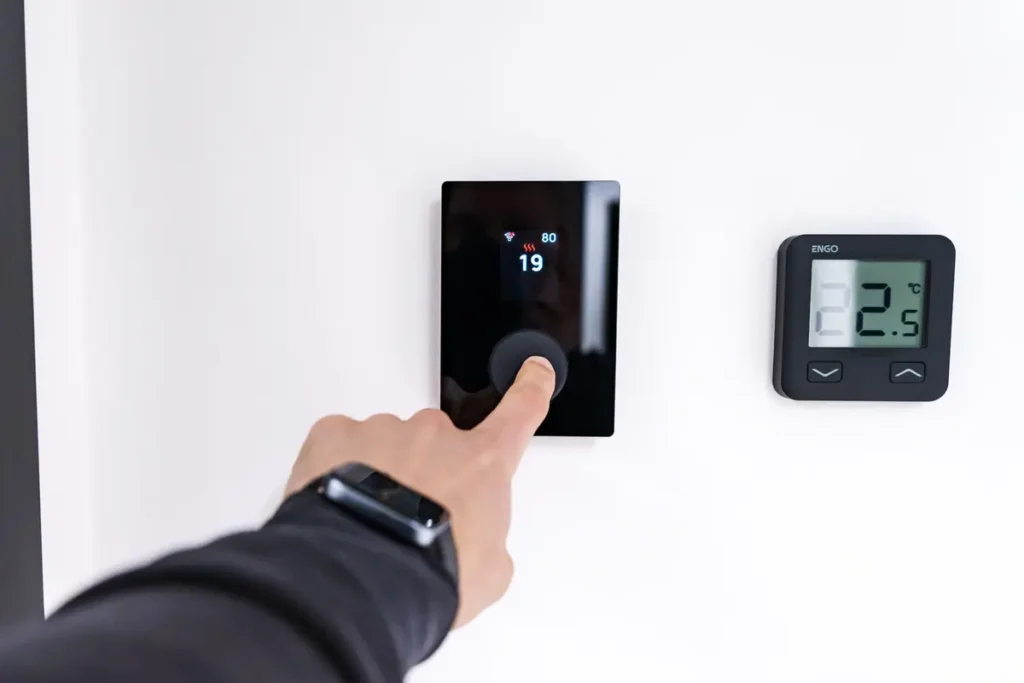
A thermostat that follows a schedule does the remembering for you. Set it to rise when the house empties and to start cooling again half an hour before you return. Avoid large swings: a setback of four to six degrees is enough. With a heat pump, which most Panhandle homes have, large changes in winter can trigger expensive strip heat, so use small steps year-round. Many smart thermostats also show daily run time, which is the easiest way to see how a change in setting affects usage.
Small changes that let you run a higher setting
- Close blinds on east windows in the morning and west windows in the afternoon.
- Replace the air filter monthly in summer.
- Run the dryer, oven and dishwasher in the evening.
- Use bathroom and kitchen exhaust fans to remove moisture at the source.
- Check the attic. Thin insulation makes every setting more expensive. Our guide to homes with higher cooling demand explains why.
If your bill is high at any setting
If you are already at 78 and the bill still hurts, the cause is the house, the equipment or the price of power. Look at duct leaks, insulation and the age of the system first. After that, the remaining lever is where your electricity comes from. Solar panels produce the most on the same long, hot afternoons when the air conditioner works hardest, which is why cooling-heavy homes in Crestview, Navarre and Panama City Beach are often good candidates. See how panel orientation relates to afternoon cooling loads, or use the solar calculator for a quick estimate.
Winter settings for a Panhandle home
The same logic works in reverse from December to February. A setting of 68 degrees when you are home, and a few degrees lower overnight, keeps a heat pump in its efficient range. Raise the temperature two degrees at a time. A jump of five or six degrees on a cold morning tells many systems to switch on their electric strip heat, which uses several times more power than the heat pump alone. If your winter bills spike in Crestview or DeFuniak Springs, strip heat is the first thing to check.
Where the thermostat sits matters
A thermostat reads the temperature of the wall it is mounted on. If it sits in direct sun, above a lamp, beside the kitchen or in a hallway that never gets airflow, it will misjudge the rest of the house. Signs of a badly placed thermostat include rooms that are much warmer than the display says, and a system that runs in short bursts. Moving it to an interior wall in a room you use is a small job for an HVAC technician and can fix comfort complaints that no setting will.
Frequently asked questions
Is 72 too cold for AC in Florida?
It is not harmful, but it is expensive. Many systems will run almost continuously on a July afternoon to hold 72, and the cost rises steeply compared with 76 or 78.
Should I turn my AC off when I go on vacation?
No. Set it to 80 to 82 so it still removes moisture. Switching it off risks mold, warped wood and a musty house.
Does setting the thermostat lower cool the house faster?
No. The system cools at the same rate whatever the setting. A lower number only makes it run longer.
What humidity should my house be in summer?
Between 45 and 55 percent is comfortable and discourages mold. A small hygrometer costs a few dollars and tells you where you stand.
Conclusion
The best thermostat setting for summer in Florida is the highest one at which your household is comfortable, and for most homes that is between 76 and 78 with fans running. Keep the fan on Auto, never switch the system off in humid weather, and use a schedule so the house is not cooled when it is empty.
MSM Solar works with homeowners in Miramar Beach and Ponce de Leon, and in every town between Pensacola and Apalachicola.
If your cooling bills are high whatever you set, it may be time to look at producing your own power. Call MSM Solar at (850) 737-5197 or request a free quote, and we will call you back no later than two business days.