
The electrical panel is the one part of the house every other system depends on, and the one most homeowners never think about until an electrician says it is full. Electrical panel upgrade cost is a common question in older Panhandle homes, where a panel installed for a 1980s household is now being asked to run two air conditioners, an induction range, an electric vehicle charger and perhaps a battery. This guide explains when an upgrade is really needed, what drives the cost, and the alternatives that sometimes avoid it.
Solar Cost Calculator – Florida Panhandle Only
* Estimate based on $3.25 per watt for solar installation.
* For Tesla Powerwall 3 Batteries, $15,000 for the first battery, $12,000 for each additional battery.
* Other variations and types of Batteries are available.
What the panel does
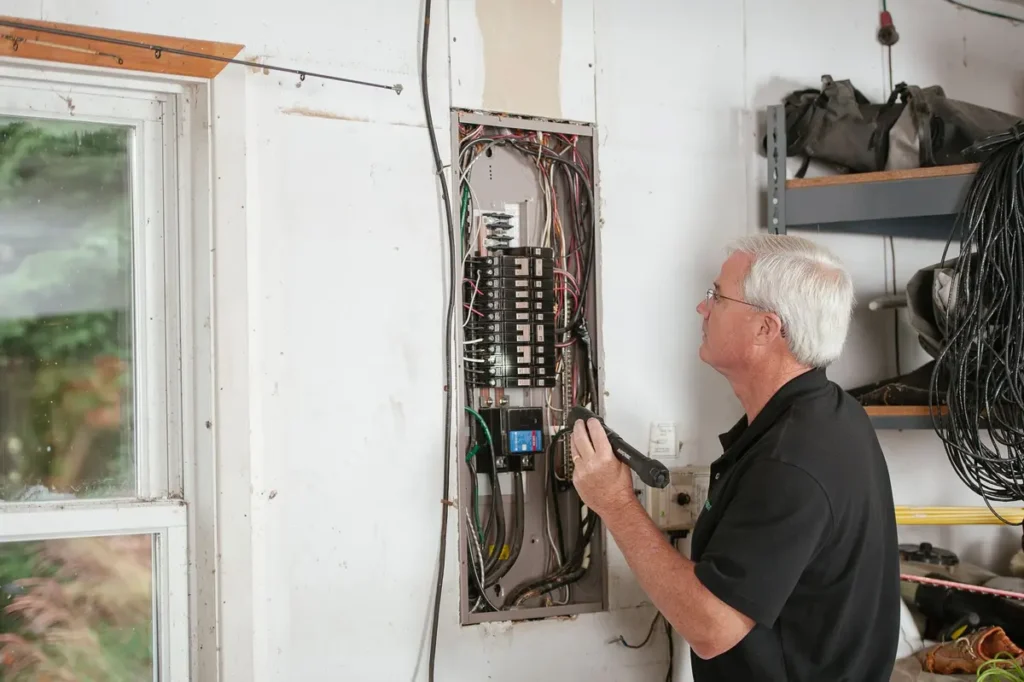
Power arrives from the utility through the meter and into the main panel, which divides it into circuits, each protected by a breaker. The panel has a rating in amps, shown on the main breaker. Common sizes are 100, 150 and 200 amps. That number is the most the house can draw at once. Many homes built before the 1990s in Pensacola, Chipley and Port St. Joe have 100 or 150 amp service. Most new homes are built with 200.
Signs you may need an upgrade
- The main breaker trips when several large appliances run together.
- Lights dim noticeably when the air conditioner or dryer starts.
- There are no free breaker spaces, and circuits have been doubled up.
- The panel is warm, buzzes, smells of burning or shows rust or scorch marks. Treat these as urgent.
- The home still has a fuse box.
- The panel is one of the older brands that electricians and insurers flag as unreliable, such as certain Federal Pacific, Zinsco and Challenger models.
- You are adding a large new load: a second AC system, an EV charger, a tankless water heater, a pool heater or a workshop.
What an upgrade involves
A service upgrade is more than swapping a metal box. It can include a new panel and breakers, a new meter base, heavier service wires from the utility connection, new grounding and bonding, a permit, an inspection, and a scheduled power shut-off with the utility. The work normally takes a day, with the power off for several hours.
What affects the cost
Prices vary widely from house to house, so ask for written quotes from licensed electricians. The main factors are:
| Factor | Why it matters |
|---|---|
| Size of the jump | 100 to 200 amps usually needs new service wires and a new meter base, not only a panel |
| Overhead or underground service | Underground service can mean trenching or new conduit |
| Where the panel is | Moving a panel out of a closet or bathroom to meet current code adds work |
| Condition of existing wiring | Aluminum branch wiring, missing grounds or damaged insulation must be dealt with |
| Permits and utility fees | Set by each county and utility |
| Extras | Whole-home surge protection, arc-fault breakers, a generator inlet |
Alternatives to a full upgrade
A bigger service is not always the answer. Ask your electrician about these first.
- A load calculation. This is the proper test of whether your service is too small. Many homes have spare capacity even with a full panel.
- A subpanel. If the problem is a lack of breaker spaces and not a lack of capacity, a subpanel adds room at much lower cost.
- Load management devices. These let two large loads share capacity by making sure they never run together, for example an EV charger that pauses while the dryer runs.
- Smart panels and smart breakers. They monitor and control individual circuits, which can avoid an upgrade and are useful with battery backup.
- More efficient equipment. A heat pump water heater or a variable-speed pool pump draws less than the unit it replaces, freeing capacity.
Panels and home insurance
Florida insurers often ask for a four-point inspection on older homes, and the electrical panel is one of the four points. A panel on an insurer's problem list, visible corrosion or evidence of overheating can lead to a requirement to replace it before a policy is issued or renewed. If you are buying an older home, look at the panel label during the inspection period so the cost can be part of the negotiation.
How the panel affects solar, batteries and EV chargers
Solar connects to your home through the panel, and there is a code rule that limits how much solar a given panel can accept, based on the rating of its bus bar and main breaker. A 200 amp panel offers more room than a 100 amp one. Where a panel is too small, there are several approved ways to connect without replacing it, including a connection on the utility side of the main breaker or a small reduction in the main breaker size where the load calculation allows. A good installer checks this at the site survey and tells you plainly whether panel work is needed.
Battery storage adds another consideration. A whole-home backup design often uses a gateway or smart panel between the meter and the house, while an essential-loads design moves chosen circuits to a backup subpanel. We compare the two in whole-home versus essential-loads backup. EV chargers and other large additions are covered in how big appliances change solar sizing.
MSM Solar comes from an aircraft electrical background, and every new installation and system addition starts with a look at the panel and the main service. Homeowners in Pensacola, Chipley and Port St. Joe can ask for a free site survey.
Frequently asked questions
How do I know what size my electrical panel is?
Look at the number on the main breaker, usually the largest breaker at the top of the panel. It will read 100, 125, 150 or 200.
Do I need a 200 amp panel for solar?
Not always. Many systems connect to smaller panels using approved methods. The site survey will show what your panel allows.
Can I upgrade a panel myself?
No. Service work involves live utility conductors, a permit and an inspection, and must be done by a licensed electrician.
How long does a panel last?
Often 25 to 40 years. Salt air, moisture and overloaded circuits shorten that, particularly for panels mounted outdoors near the coast.
Conclusion
Electrical panel upgrade cost depends on how far the service has to grow and what the existing wiring is like, so start with a load calculation and a written quote. Often a subpanel or load management does the job for less. When a full upgrade is needed, it is a good moment to add surge protection and plan for the loads you expect over the next decade.
MSM Solar works with homeowners in Altha, Apalachicola, Blountstown, Bonifay and DeFuniak Springs, and in every town between Pensacola and Apalachicola.
If solar, a battery or an EV charger is part of that plan, we can tell you what your panel will support. Call MSM Solar at (850) 737-5197 or request a free quote, and we will call you back no later than two business days.