
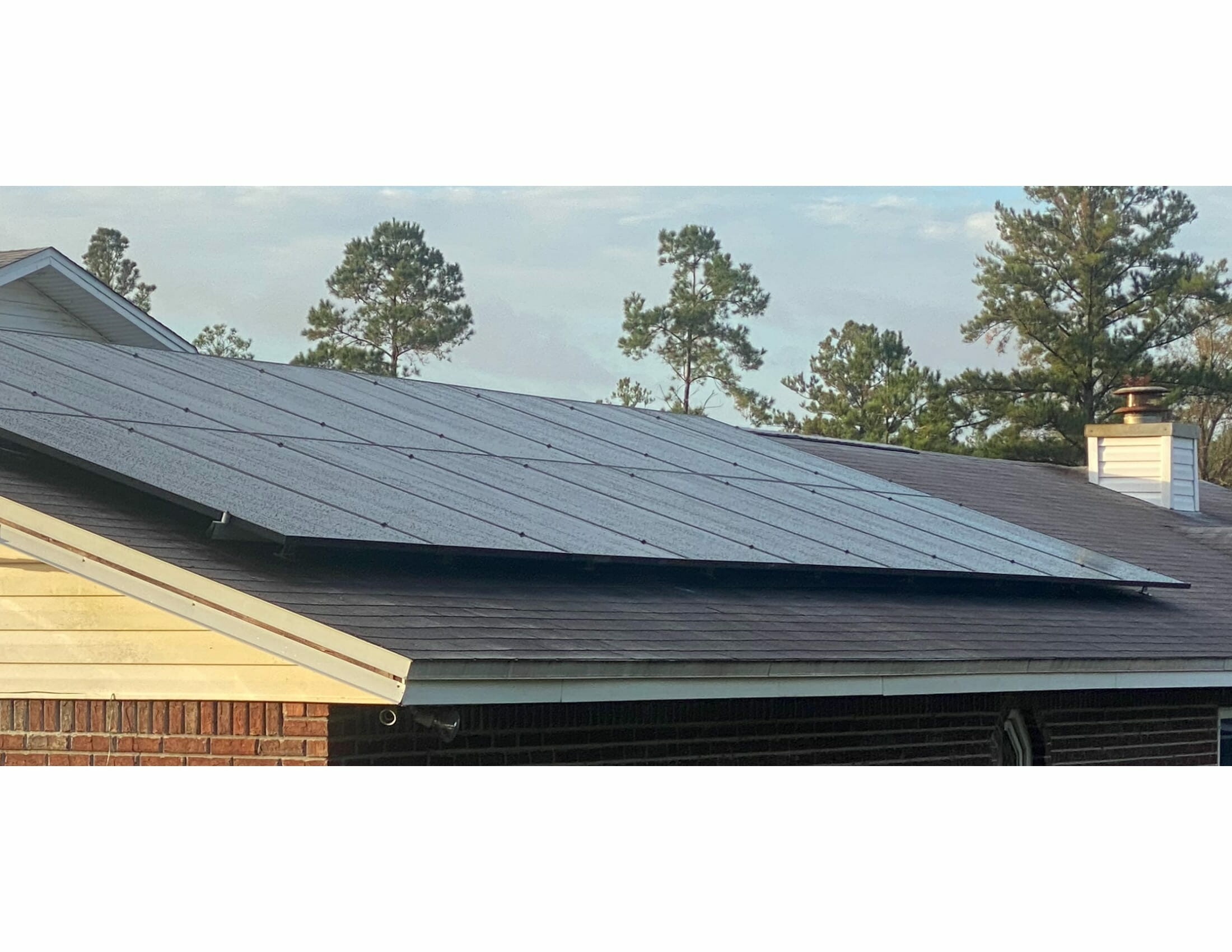
No. In Florida, a homeowners association cannot ban solar panels on a home you own. State law (Section 163.04 of the Florida Statutes) stops deed restrictions, covenants and HOA rules from prohibiting solar collectors. What an HOA can do is have a say in where the panels go on your roof, within limits, and require you to follow its normal architectural review process. Here is how that works in practice for Florida Panhandle homeowners.
What Florida law says about HOAs and solar
Florida's solar rights law is short and has been on the books for decades. In plain terms, it says that no deed restriction, covenant, declaration or similar binding agreement may prohibit the installation of solar collectors on a building. The same section also covers clotheslines and other energy devices based on renewable resources.
The key points for a homeowner are:
- An HOA cannot say "no solar" in its covenants or rules, and a rule written that way is not enforceable against a solar installation.
- The HOA may decide the specific location on the roof where panels go, but only within an orientation to the south or within 45 degrees east or west of due south.
- That location choice cannot impair the effective operation of the system. An HOA cannot push your panels onto a shaded or north-facing section to make them less visible if that would cripple production.
This is a summary, not legal advice. If your HOA disputes your rights, a Florida real estate attorney can read your specific declaration alongside the statute.
What an HOA can still control
Having the right to install solar does not mean you can skip the HOA entirely. Most associations in Okaloosa, Santa Rosa, Walton and Bay counties have an architectural review committee (ARC) or architectural control board, and the law does not remove that process. It is reasonable for an HOA to ask for:
- A written application before work starts.
- A site plan or roof layout showing where the panels and equipment will go.
- Equipment details, such as panel color and racking.
- Placement of conduit, inverters and disconnects so they are tidy and, where practical, out of street view.
Requests like these are generally fine as long as they do not amount to a ban or make the system ineffective. Where things go wrong is when an HOA tries to require a location that faces north, sits under heavy tree shade, or is too small to fit a useful system. That is the point where the statute protects the homeowner.
Where the panels can go: the south-facing rule explained
The law gives the HOA a say over roof location only within a range of directions: due south, or up to 45 degrees toward the east or west. Here in the Panhandle, south-facing roof planes generally produce the most energy over a year, and southeast and southwest planes also perform well. East and west planes can work too, with somewhat lower output.
What this means in practice:
- If your best roof plane faces south, southeast or southwest, the HOA may have input on exactly where on that plane the array sits.
- If your only usable roof faces east or west, the HOA's location power is less clear-cut, and an attorney's reading of your documents matters more.
- Whatever the HOA asks for still cannot impair effective operation.
A good installer will design a layout that is efficient and looks clean from the street, which often removes the conflict before it starts. MSM Solar's free site survey includes a roof layout you can attach to your HOA application. You can learn more on our new solar installations page.
How to get HOA approval without delays
Most HOA solar applications in the Panhandle go smoothly when the paperwork is complete. A simple sequence that tends to work:
- Read your documents first. Look up your declaration of covenants and any architectural guidelines. Note the application form, submission address, and how many days the committee has to respond.
- Get a written quote and layout. The roof layout shows panel locations and makes it easy for the committee to picture the finished result.
- Submit everything at once. Include the layout, panel and racking specifications, and a short note on where the inverter, disconnect and conduit will be mounted.
- Keep copies and dates. Save the application and any responses in writing.
- Respond to reasonable requests. Moving conduit or choosing all-black panels is usually a small change that keeps everyone happy.
HOA approval is separate from the building permit. Your county or city building department still has to issue a permit, and your utility still has to approve the interconnection, whether that is FPL or a co-op such as CHELCO or Gulf Coast Electric. Those approvals do not depend on the HOA, but it is sensible to have HOA sign-off before installation day.
Condos, townhomes and ground-mounted systems
The solar rights law is clearest for a single-family home where the owner controls the roof. Other situations are more complicated:
- Condominiums. In many condos the roof is a common element owned by the association, not the individual unit owner. Putting panels on a shared roof usually needs association approval and may involve other parts of Florida condominium law. Ask an attorney before planning around a common roof.
- Townhomes. It depends on who owns and maintains the roof over your unit. If you own your roof section, your position is closer to a single-family home. If the association owns it, treat it more like a condo.
- Ground mounts. The statute's location language is written around roofs. An HOA may have more say over a ground-mounted array in a yard, so check your rules on structures, setbacks and screening early.
What to do if your HOA says no
A flat denial is uncommon, but it does happen, usually because a board is working from older guidelines. If it happens to you:
- Ask for the denial and the reason in writing.
- Politely point the board to Section 163.04 of the Florida Statutes and ask whether a different location within the south-to-45-degree range would satisfy them.
- Offer reasonable design changes, such as panel color or conduit routing.
- If the board still refuses, speak with a Florida real estate attorney before you install. Do not start work in the middle of an unresolved dispute.
Many disputes end once the board sees the statute and a professional layout. Calm, documented communication tends to work better than an argument at a board meeting.
Costs and incentives to keep in mind
HOA approval does not change the economics of solar, but it is worth knowing where things stand now. The 30% federal residential solar tax credit ended for systems installed after December 31, 2025, so it is not available for new homeowner installs. Florida still exempts solar equipment from sales tax, and the added home value from solar is excluded from property tax assessments. There is no Florida state solar tax credit or statewide rebate.
On the utility side, FPL now serves the former Gulf Power territory and credits net-metered exports at the retail rate. Co-ops and city utilities set their own rules, so check with yours. MSM Solar's typical pricing is about $3.25 per watt installed, and we provide free site surveys and written quotes. Use our calculator below for a rough estimate for your home.
Solar Cost Calculator – Florida Panhandle Only
* Estimate based on $3.25 per watt for solar installation.
* For Tesla Powerwall 3 Batteries, $15,000 for the first battery, $12,000 for each additional battery.
* Other variations and types of Batteries are available.
Frequently asked questions
Can my HOA make me remove solar panels I already installed?
Not simply because they are solar panels, since a ban is not enforceable under Florida law. If you skipped the HOA application process, though, the association may still raise issues about procedure or placement. Talk to an attorney if you receive a removal demand.
Can my HOA require panels on the back of the house only?
Only if the back of the house falls within the south-to-45-degree range and the location would not impair the system's effective operation. If the rear roof faces north, the HOA generally cannot force panels there.
Does the HOA have to approve a battery or Powerwall?
Many batteries are mounted inside a garage or on a side wall, which may still fall under architectural rules for exterior equipment. Check your guidelines, and include the battery location in your application to be safe.
Does HOA approval replace the building permit?
No. Your county or city building department issues the permit, and your utility approves interconnection. HOA approval is a separate private step.
Conclusion
MSM Solar works with homeowners in Laurel Hill, Mary Esther, Mexico Beach, Pace, Perdido Key, Ponce de Leon and Rosemary Beach, and in every town between Pensacola and Apalachicola.
Florida law protects your right to go solar, even in a neighborhood with strict covenants. Your HOA can review your plans and influence where panels go within the south-facing range, but it cannot ban them or force a layout that ruins production. Start with your HOA documents, submit a complete application with a professional layout, and keep everything in writing. Homeowners from Crestview to the coast can request a free site survey and written quote from MSM Solar, a Florida Certified Solar Contractor (License CVC57236), at (850) 737-5197.