
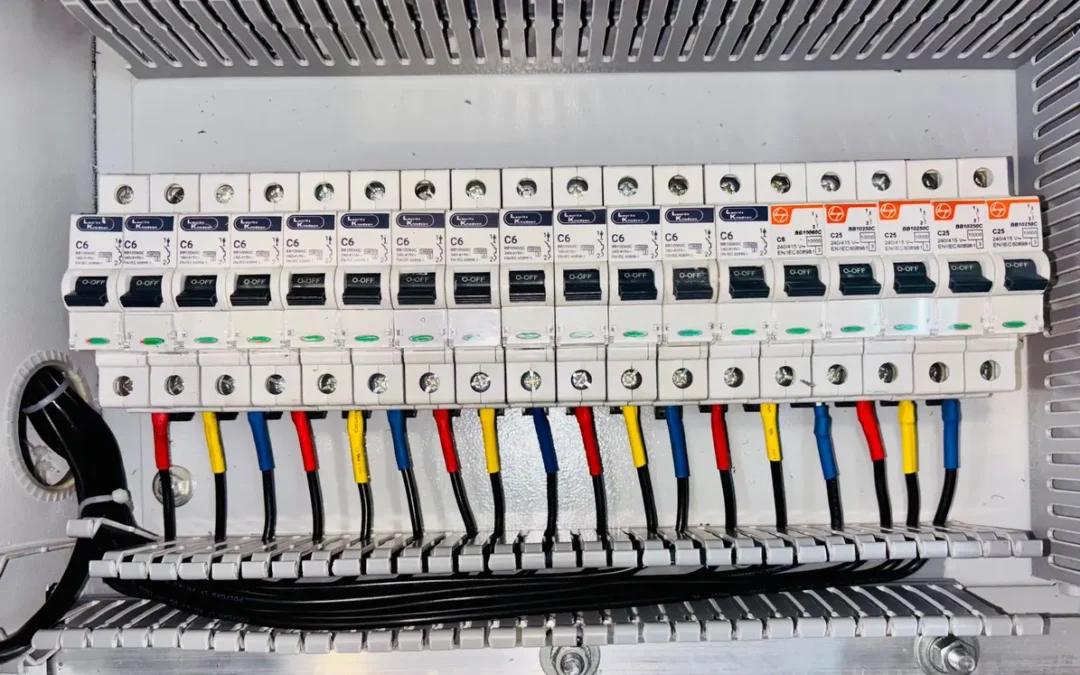
The solar 120% rule is an electrical code limit on how much solar power can be fed back through the breakers in your main electrical panel. In short, the main breaker plus the solar breaker (sized at 125% of the inverter's output current) cannot add up to more than 120% of the panel's busbar rating. On a typical 200-amp panel with a 200-amp main breaker, that leaves room for roughly a 7.6 kW inverter. Larger systems are still possible, but they need a different connection method, a smaller main breaker or a new panel.
This guide explains what the rule means in plain terms, how to check your own panel, and the options an installer has when the numbers do not work. It is written for homeowners in the Florida Panhandle who are comparing quotes and want to understand why one proposal includes panel work and another does not.
What the solar 120% rule actually says
Every main electrical panel has a busbar, the metal strip inside the panel that the breakers clip onto. The busbar has a current rating printed on the panel label, often 100, 150, 200 or 225 amps. The main breaker protects that busbar from carrying more current than it was built for.
When a grid-tied solar system connects through a breaker in that same panel, the busbar can be fed from two directions at once: from the utility through the main breaker, and from the solar inverter through its own breaker. The National Electrical Code, which Florida adopts through its building code, allows that only if the total possible current stays within a safe margin. The most common way to meet the requirement is the 120% rule:
- Multiply the panel's busbar rating by 1.2.
- Subtract the rating of the main breaker.
- What is left is the largest solar breaker allowed. The solar breaker itself must be sized at 125% of the inverter's continuous output current.
- The solar breaker must sit at the opposite end of the busbar from the main breaker, so current from the two sources does not stack up in one spot.
The rule exists because a busbar overheats when it carries more current than it is rated for, and an overloaded busbar is a fire risk hidden inside a closed panel. It is a safety limit, not paperwork for its own sake.
Working through the math on common panels
Here is how the arithmetic plays out on panels that show up often in homes around Crestview, Niceville and Pensacola. These are code calculations, not quotes, and your inverter's exact output current comes from its spec sheet.
| Busbar rating | Main breaker | 120% of busbar | Largest solar breaker | Approx. inverter size at 240 V |
|---|---|---|---|---|
| 100 A | 100 A | 120 A | 20 A | About 3.8 kW |
| 200 A | 200 A | 240 A | 40 A | About 7.6 kW |
| 200 A | 175 A (derated) | 240 A | 60 A | About 11.5 kW |
| 225 A | 200 A | 270 A | 70 A | About 13.4 kW |
The inverter size column comes from dividing the breaker rating by 1.25 to get the allowed continuous current, then multiplying by 240 volts. A 40-amp breaker allows 32 amps of continuous inverter output, which is about 7.7 kW. Breakers come in standard sizes, so on the derated panel the math allows 65 amps but the practical choice is the next standard size down, 60 amps. Notice how much a 225-amp busbar helps: the same 200-amp main breaker leaves far more room for solar.
Inverter output is measured in AC kilowatts, which is often smaller than the DC size of the panels on your proposal. A larger array paired with a smaller inverter can still fit under the limit, because the rule looks at what the inverter can push into the panel, not the nameplate of the panels on the roof.
How to check your own panel before you get quotes
You can gather most of what an installer needs in a few minutes. Do not remove the panel's inner cover (the dead front); everything below is visible with the door open.
- Find the label. Inside the panel door or on the side wall there is a label listing the manufacturer, model and busbar rating, sometimes written as bus rating or rated amperes.
- Read the main breaker. The large breaker at the top or bottom has its rating printed on the handle, for example 100, 150 or 200.
- Note open slots. A solar breaker usually needs two open spaces, ideally at the end of the busbar opposite the main.
- Look for a second panel. Many homes have a meter-main combination outside and a separate distribution panel inside. Where the solar connects matters, so photograph both.
- Take clear photos. A photo of the label, the main breaker and the full breaker layout lets an installer spot problems before the site visit.
If the label is missing, painted over or unreadable, say so up front. The installer will need to identify the panel another way, and that is better known before a quote than after.
Option 1: Derate the main breaker
If your home does not actually use the full capacity of its main breaker, an electrician can swap it for a smaller one. Going from a 200-amp main to a 175-amp main on a 200-amp busbar opens up room for a 60-amp solar breaker, as the table shows.
This only works when a load calculation shows the house can live with the smaller main. Homes with a large heat pump, electric water heater, electric range, pool equipment and an EV charger may not have that margin. Derating also depends on a listed replacement breaker being available for that panel model. When it fits, it is usually the least disruptive fix.
Option 2: A supply-side (line-side) connection
Instead of connecting through a breaker on the busbar, the solar system can be tied in between the utility meter and the main breaker. Because the solar current never passes through the busbar, the 120% rule does not limit it in the same way. This is often called a line-side tap or supply-side connection.
It needs its own fused disconnect, enough physical room in the service equipment to make the connection properly, and approval from the building department and the utility. Some meter-main combinations make this straightforward; others have no code-compliant place to make the tap. Utilities set their own interconnection requirements, so whether the home is served by FPL or by a co-op such as CHELCO, Gulf Coast Electric or West Florida Electric affects the plan.
Option 3: Replace or upgrade the panel
Sometimes the cleanest answer is a new panel, for example a 200-amp panel with a 225-amp busbar, which leaves more headroom for solar. This makes sense when the existing panel is old, out of spaces, from a brand with a poor safety record, or when the home also needs more capacity for an EV charger or added air conditioning.
A panel replacement involves a permit, coordination with the utility to disconnect and reconnect service, and more cost than a breaker swap. Our guide to electrical panel upgrade costs in Florida covers what drives that price and when a home really needs 200 amps.
Other approaches installers may use
Recent editions of the electrical code also recognize power control systems, which electronically limit current on the busbar so it can never exceed its rating. Some inverters, batteries and smart panels, like those covered in our article on smart electrical panels and home batteries, can be part of that approach. Whether it is accepted depends on the equipment's listing and the local inspector.
Another approach is simply sizing the inverter to fit. If the household's usage only calls for a modest system, a design that stays under the limit avoids electrical work entirely. If you plan to add panels later, mention it early so the first design leaves room; our page on adding to an existing solar system explains how expansions are handled.
What this means for your solar quote
When comparing proposals, look for a line that explains how the system connects to your home. A clear proposal names the connection method, the breaker size and any panel work included. If two quotes differ a lot, check whether one includes a main breaker derate or line-side tap while the other assumes the panel will pass without changes.
Questions worth asking any installer:
- What is my busbar rating and main breaker size, and does this design pass the 120% rule as-is?
- If not, which fix are you using, and is it included in the price?
- Does the plan leave room to add a battery or more panels later?
- Who handles the permit and the utility paperwork for the connection?
MSM Solar looks at the electrical panel during every free site survey for new solar installations, from Crestview to the coast, and the written quote states how the system will connect. Typical installed pricing is about $3.25 per watt, and any panel work needed is listed in the quote rather than added later.
Solar Cost Calculator – Florida Panhandle Only
* Estimate based on $3.25 per watt for solar installation.
* For Tesla Powerwall 3 Batteries, $15,000 for the first battery, $12,000 for each additional battery.
* Other variations and types of Batteries are available.
Frequently asked questions
Does the 120% rule apply to battery systems too?
Yes. A battery inverter that can send current through a breaker on the busbar counts toward the same calculation. When solar and a battery both connect to one panel, their combined output current matters, which is one reason battery projects sometimes include panel work.
Can I just use a bigger solar breaker if the system is larger?
No. The breaker must match the inverter's output and stay within the panel's limit. Oversizing a breaker to get around the rule defeats the protection it provides and will not pass inspection.
Is a line-side tap safe?
When it is designed and installed to code with a proper fused disconnect, and approved by the inspector and the utility, it is a standard connection method. It should only be done by a licensed contractor, because it involves conductors that are energized ahead of the main breaker.
My house has a 100-amp panel. Can I still go solar?
Often, yes. A small system may fit as-is, or the project may include a line-side connection or a panel upgrade. A site survey with photos of the panel is the fastest way to know which applies.
Conclusion
The solar 120% rule is one of the most common reasons a solar quote includes electrical work, and it is easy to follow once you know your busbar rating and main breaker size. Many homes fit a mid-sized system without changes; others need a derated main, a supply-side connection or a new panel. Knowing which applies before you sign keeps the price and the schedule honest.
MSM Solar works with homeowners in Seaside, St. George Island, Tallahassee, Wewahitchka and Alford, and in every town between Pensacola and Apalachicola.
MSM Solar is based in Crestview at 5662 Old Bethel Rd and holds Florida Certified Solar Contractor License CVC57236. Call (850) 737-5197 or request a free site survey, and a real person will call you back within 2 business days.