Florida sees more lightning than any other state, and the Panhandle gets its share on almost every summer afternoon. A whole home surge protector is a small device fitted at the electrical panel that is meant to stop voltage spikes before they reach your appliances. With modern homes full of circuit boards, from the air conditioner to the fridge to the garage door opener, it is one of the cheaper forms of protection a homeowner in Crestview, Pace or Lynn Haven can buy. Here is what it does, what it does not do, and how to decide whether you need one.
Solar Cost Calculator – Florida Panhandle Only
* Estimate based on $3.25 per watt for solar installation.
* For Tesla Powerwall 3 Batteries, $15,000 for the first battery, $12,000 for each additional battery.
* Other variations and types of Batteries are available.
What a power surge is
A surge is a brief spike in voltage above the normal level. Most last only a fraction of a second. Large ones can destroy electronics instantly. Smaller ones, repeated over months, wear components down until they fail early, often with no obvious cause.
Where surges come from
- Lightning. A strike does not need to hit your house. One that lands on a power line or the ground nearby can send a spike through the utility wiring, the cable line or the phone line.
- Utility switching and repairs. When power is restored after an outage, or the utility switches equipment, voltage can jump.
- Fallen lines and vehicle accidents. A higher-voltage line touching a lower-voltage one sends a damaging surge to every home on it.
- Inside your own house. Most surges are small and home-made. Every time an air conditioner compressor, well pump, pool pump or refrigerator starts and stops, it sends a ripple through the wiring.
How a whole-home surge protector works
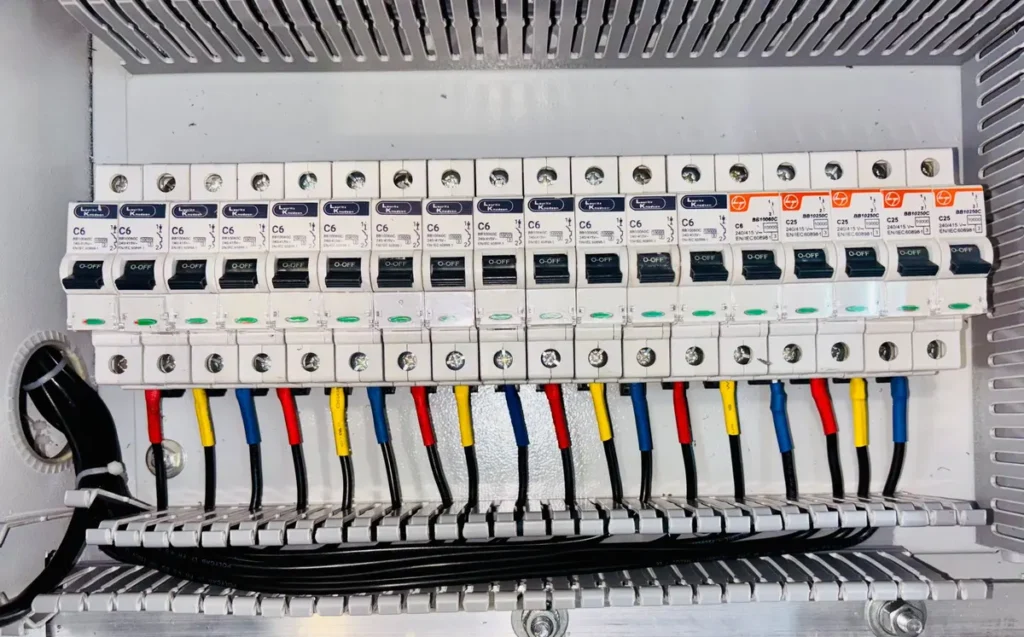
The device, often called an SPD (surge protective device), connects to the main panel. It watches the voltage, and when a spike arrives it diverts the excess to the grounding system within billionths of a second. Because it sits at the panel, it protects every circuit in the house, including hard-wired equipment that cannot be plugged into a power strip: the air conditioner, water heater, oven, well pump and dishwasher.
Types of protection
| Type | Where it goes | What it does |
|---|---|---|
| Type 1 | Between the utility and the main breaker, sometimes at the meter | Handles large external surges; some utilities offer these on a monthly plan |
| Type 2 | At the main panel, on a breaker | The standard whole-home protector; covers external and internal surges |
| Type 3 | Plug-in strips at the outlet | A final layer for computers, TVs and audio equipment |
The best protection is layered: a Type 2 device at the panel, and good-quality plug-in protectors at sensitive electronics. Each one deals with what the previous one lets through.
What it will not do
- It will not protect against a direct lightning strike to the house. That requires a lightning protection system with rods and conductors, which is a separate installation.
- It does not last forever. The internal components absorb a little damage with every surge. Most units have an indicator light that shows when protection has ended. Check it after major storms.
- It depends on good grounding. If the grounding rods and connections at your home are corroded or loose, the device has nowhere to send the surge. An electrician should check grounding at installation.
- It does not protect cable, satellite or phone lines unless those have their own protectors where they enter the house.
What to look for when buying
- A UL 1449 listing, which is the safety standard for surge protective devices.
- A surge current rating suited to a lightning-prone area. Higher is better; your electrician can recommend a level.
- A clear status indicator, and ideally an audible alarm.
- A warranty on the device itself. Treat connected-equipment warranties with caution and read the conditions.
- Installation by a licensed electrician, as close to the main breaker as possible with short, straight wires.
Is it required?
Recent editions of the National Electrical Code require surge protection for dwelling services in new construction and when a service is replaced. That means newer homes and recently upgraded panels may already have one. Older homes across Escambia, Santa Rosa and Bay County usually do not. Open the panel door and look for a labeled device with a small light, or ask an electrician during any other electrical work.
Surge protection and solar systems
A solar array adds valuable electronics to the home: inverters or microinverters, optimizers, a battery and communication equipment. These sit on the roof and the outside wall, with wiring that can pick up induced surges during a nearby strike. A well-designed system includes protection on both the DC side and the AC side. If you have solar and are not sure what protection was installed, it is worth asking. We have written more about this in why surge protection is important for solar systems, and about short interruptions in how solar systems handle power flickers and grid events.
MSM Solar services systems of any brand and age, including those whose installer has closed. If your inverter stopped working after a storm, a service call will find out whether a surge was the cause and whether the equipment is still under manufacturer warranty. For a new system in Crestview, Pace or Lynn Haven, surge protection is part of the design conversation from the start.
Frequently asked questions
Do I need a whole-home surge protector if I use power strips?
Yes, if you want to protect hard-wired equipment. Power strips cover only what is plugged into them, and many cheap strips offer little real protection.
How long does a whole-home surge protector last?
It depends on how many surges it absorbs. Many last several years. Check the indicator light a few times a year and after severe storms.
Will it lower my electric bill?
No. It protects equipment. It does not reduce energy use.
Does homeowners insurance cover surge damage?
Many policies cover lightning damage, but cover for other surges varies and deductibles apply. Check your policy wording.
Conclusion
In the lightning capital of the country, a whole home surge protector is a modest cost set against the electronics it guards. Fit a Type 2 device at the panel, add plug-in protection for sensitive equipment, have the grounding checked, and look at the indicator light after big storms.
MSM Solar works with homeowners in Rosemary Beach, Seaside, St. George Island, Wewahitchka and Alford, and in every town between Pensacola and Apalachicola.
If you have solar equipment that misbehaved after a storm, or you are planning a system and want it protected properly, call MSM Solar at (850) 737-5197 or request a free quote, and we will call you back no later than two business days.