
Electric vehicles are now a common sight from Pensacola to Panama City Beach, and the first question new owners ask is about charging at home. EV charger installation cost varies more than most people expect, because the charger itself is often the smaller part of the bill. The distance from your electrical panel to the parking spot, the capacity of the panel and the permit all matter. This guide explains the options and what moves the price up or down.
Solar Cost Calculator – Florida Panhandle Only
* Estimate based on $3.25 per watt for solar installation.
* For Tesla Powerwall 3 Batteries, $15,000 for the first battery, $12,000 for each additional battery.
* Other variations and types of Batteries are available.
The three levels of charging
| Level | Power source | Typical range added per hour | Where you find it |
|---|---|---|---|
| Level 1 | Standard 120-volt outlet | About 3 to 5 miles | Any household outlet, using the cable supplied with the car |
| Level 2 | 240-volt circuit, like a dryer | About 20 to 40 miles | Home chargers and most public stations |
| DC fast charging | High-voltage commercial equipment | Most of a battery in under an hour | Highway and retail sites only |
For a driver covering 30 to 40 miles a day, Level 1 can be enough if the car is plugged in every night. Most owners choose Level 2 for the freedom of refilling a nearly empty battery overnight.
What goes into the installation cost
- The charger. Wall units range from basic to smart, with Wi-Fi, scheduling and energy tracking. Some cars come with a portable unit that plugs into a 240-volt outlet.
- The circuit. A dedicated 240-volt circuit with the correct breaker and wire size. Common charger circuits are 40, 50 or 60 amps.
- The distance. A charger on the other side of the wall from the panel is a short, simple job. A run across an attic to a detached garage or through a trench to a carport costs more in wire, conduit and labor.
- The panel. If the panel has no spare capacity, you may need load management or an upgrade.
- Permit and inspection. Required by Florida counties for a new circuit.
- Outdoor mounting. Weather-rated equipment and, near the coast, corrosion-resistant fittings.
A straightforward garage installation near the panel sits at the low end. Long runs, trenching or panel work can multiply the figure. Get a written quote that lists each of these items.
Hardwired or plug-in?
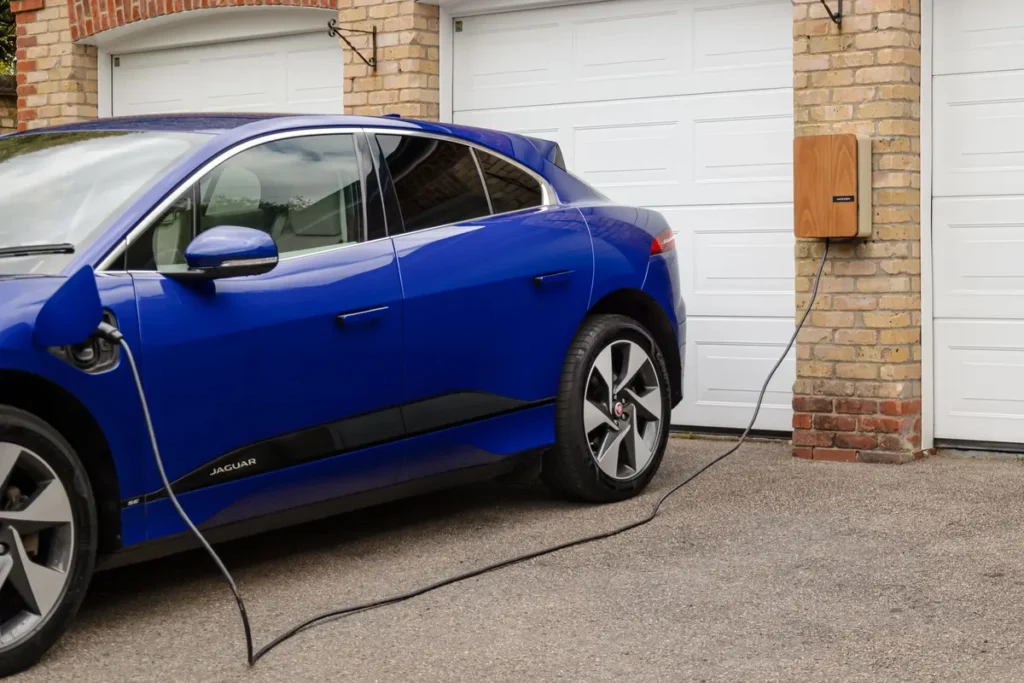
A plug-in charger connects to a 240-volt outlet and can be unplugged and taken with you. A hardwired charger is wired directly to the circuit. Hardwired units can usually deliver more power, have fewer connections to wear out, and are preferred outdoors. Plug-in units are convenient if you rent or expect to move. Either way, use a high-quality industrial-grade outlet, because cheap outlets have been known to overheat under hours of continuous load.
Does your panel have room?
An EV charger is a large continuous load. An electrician should carry out a load calculation before installing one. If your panel is close to its limit, there are options short of a full service upgrade:
- Set the charger to a lower current. Charging at 24 or 32 amps overnight still refills most daily driving.
- Fit a load management device that pauses the charger when the dryer, range or air conditioner is running.
- Choose a smart charger that monitors the home's total draw and adjusts itself.
What it costs to charge at home
Charging at home is priced by the kilowatt-hour like any other appliance. To estimate it, take the miles you drive each month, divide by your car's efficiency in miles per kilowatt-hour (commonly 3 to 4), and multiply by your electricity rate. A driver covering 1,000 miles a month in a car that manages 3.5 miles per kilowatt-hour uses about 285 kilowatt-hours. For most households that is noticeably cheaper than gasoline for the same distance, and it shows up as an increase on the electric bill that is worth planning for.
Tips for an outdoor charger on the Gulf Coast
- Choose a unit rated for outdoor use and mount it out of direct afternoon sun if possible.
- Keep the connector off the ground and capped when not in use.
- In flood zones, mount the unit above the expected flood level.
- Unplug the car before a hurricane and do not charge during a lightning storm if you can avoid it.
- Ask for whole-home surge protection at the panel at the same time.
Charging from your own solar
An EV is the largest new electrical load most households will ever add, and it is also the easiest to schedule. That makes it a natural partner for rooftop solar. If the car is home during the day, a smart charger can be set to charge when the panels are producing. If it is home only at night, a solar system sized for the extra usage offsets the charging over the course of the month, and a battery can shift some daytime production into the evening.
If you already have solar, adding an EV means your system now covers a smaller share of your usage, and it may be worth adding panels. We look at this in how pool pumps, EVs and HVAC skew solar calculations and in understanding base load.
MSM Solar installs EV chargers alongside solar additions, battery storage and generator inlets, and can add capacity to an existing system from any installer. We check the panel first and tell you what it will support. Homeowners in Pensacola, Destin, Panama City Beach and the towns between can book a free site survey.
Frequently asked questions
Can I install an EV charger myself?
A new 240-volt circuit needs a permit and should be installed by a licensed electrician. Incorrect wiring on a continuous high-current load is a fire risk.
Do I need a 200 amp panel for an EV charger?
Not necessarily. A load calculation decides it. Many 100 and 150 amp homes can add a charger at reduced current or with load management.
How long does Level 2 charging take?
Most cars refill from low to full in 6 to 10 hours, which fits an overnight stop. Daily top-ups take far less.
How many solar panels does it take to charge an EV?
It depends on how far you drive. As a rough guide, typical commuting adds the output of a handful of panels to your needs. A site survey gives an exact figure.
Conclusion
EV charger installation cost is driven by distance from the panel, panel capacity and whether the unit is indoors or outdoors, far more than by the charger you pick. Get a load calculation, choose a sensible charging current, and ask for a written quote that lists the circuit, permit and any panel work.
MSM Solar works with homeowners in Chipley, Fort Braden, Fort Walton Beach, Fountain and Freeport, and in every town between Pensacola and Apalachicola.
If you would like to charge from your own roof, or add a charger to an existing solar system, call MSM Solar at (850) 737-5197 or request a free quote, and we will call you back no later than two business days.