
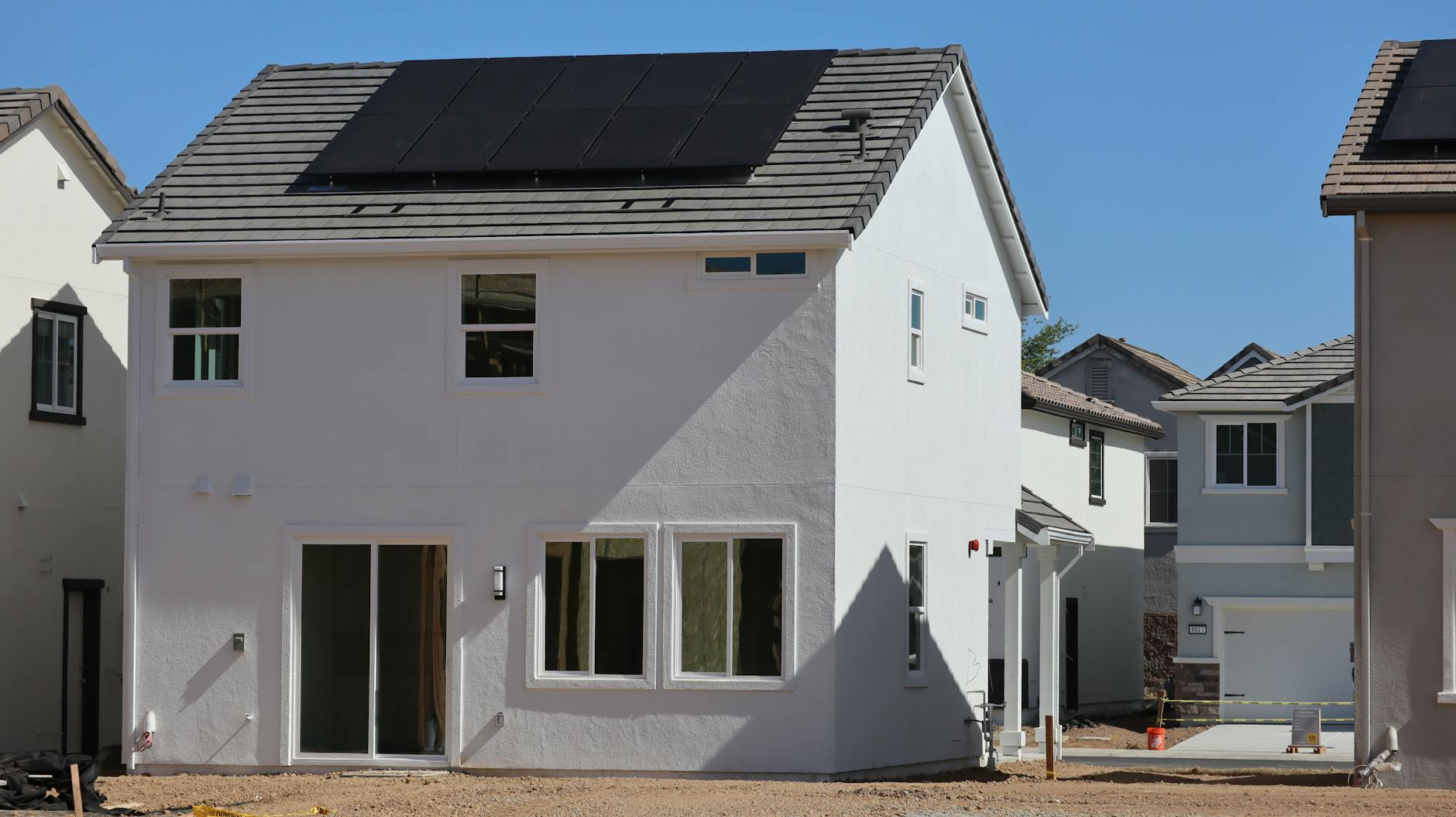
Yes, a detached garage, workshop or barn can often carry a solar array, and sometimes it is a better spot than the house roof. Whether it works for your property comes down to four things: whether the building is structurally sound enough for panels and Panhandle wind loads, how much sun the roof gets, how far the building is from your main electrical panel, and whether the building has its own utility meter. This guide walks through each one so you know what to look at before you ask for a quote.
Why put solar on an outbuilding instead of the house?
Homeowners usually look at an outbuilding for one of these reasons:
- The house roof faces the wrong way or is shaded, while the shop or barn roof faces south or west with open sky.
- The house roof is complicated, with dormers, valleys and vents that leave little open space for panels.
- The house roof is near the end of its life and the owner does not want to re-roof yet.
- The outbuilding has a large, simple roof, such as a metal pole barn or a wide shop, that can fit more panels.
- The owner prefers not to have panels visible on the house.
On rural lots around DeFuniak Springs, Marianna and Milton, a big shop or barn roof is often the most practical surface on the property.
Is the building strong enough for solar panels?
Solar panels add weight, but the bigger concern in the Panhandle is wind. During a tropical storm or hurricane, wind tries to lift panels off the roof, and that force is carried through the racking into the roof framing. The array has to be attached to structural members, not just roof sheathing, and the design must meet the Florida Building Code for your location.
Things that affect whether an outbuilding is a good candidate:
- Framing: rafters or trusses in good condition, without rot, sagging or termite damage. Light-gauge prefab sheds may not be suitable.
- Pole barns and metal buildings: these can work well, but purlin spacing and gauge matter, and some need an engineer's review.
- Permitted construction: a building that was permitted and inspected is usually easier to approve for solar than one built without a permit.
Expect a site survey to include a look at the framing from inside the building. If extra engineering is needed, it should be spelled out in the written quote.
Roof condition, direction and shade
The same rules apply to an outbuilding roof as to a house roof. South-facing roofs generally produce the most, with west and east also workable in Florida. Shade from nearby trees, especially tall pines, can cut output significantly. Roofing material matters too: standing-seam and exposed-fastener metal roofs, which are common on shops and barns, are well suited to solar mounting.
If the roof covering is old, it is usually worth replacing it before the panels go on. Taking an array off and putting it back later costs money that a new roof up front would avoid.
Getting the power back to the house
This is the part that most often decides whether an outbuilding array makes sense. The power the panels make has to reach the point where your home connects to the utility. There are two common approaches:
- Connect through the outbuilding's existing subpanel. If the garage or shop already has a subpanel fed from the house, the solar may be able to connect there. The limit is the size of the feeder wire and breakers that already run between the buildings; the electrical code restricts how much solar can be added on an existing feeder.
- Run a dedicated circuit back to the main panel or meter. This usually means trenching between the buildings and pulling new conductors in conduit. It costs more but avoids the limits of the existing feeder.
Distance matters. The farther the building is from the house, the larger the wire has to be to keep power losses low, and the longer the trench. A shop 30 feet from the house is a very different job from a barn 300 feet down a driveway. Obstacles such as driveways, septic fields, irrigation lines and tree roots also affect the trenching route.
What if the outbuilding has its own meter?
Some barns and shops, particularly on farms and larger lots, have a separate utility service with their own meter. In that case the array can usually connect to that service instead of the house. The catch is that solar on a separate meter offsets only the usage on that meter. If the shop uses little electricity and most of your usage is at the house, a lot of the production would be exported rather than used.
How exported energy is credited depends on your utility. FPL, which now serves the former Gulf Power territory, credits net-metered exports at the retail rate. Electric cooperatives such as CHELCO, Gulf Coast Electric, West Florida Electric, Escambia River Electric and Talquin, and city utilities, set their own rules. Ask your utility how it treats a second meter before deciding which service to connect to.
Permits, inspections and utility approval
An outbuilding array goes through the same steps as a rooftop system on a house: a building and electrical permit from your city or county, inspections, and an interconnection application with your utility. The utility gives permission to operate before the system is switched on. Your installer should handle the paperwork, and the trenching and any feeder work are typically part of the same electrical permit.
Batteries and backup with an outbuilding array
If you want backup power, the battery is usually installed near the house's main panel, not out in the shop, so it can keep essential household circuits running during an outage. Solar on the outbuilding can still recharge it, as long as the wiring is designed for that from the start. If backup is part of your plan, mention it at the site survey; adding it later can mean rerouting conductors.
Costs to budget beyond the panels
MSM Solar's typical installed pricing is about $3.25 per watt, and about $15,000 for a first Tesla Powerwall 3. An outbuilding array can add costs a house roof does not have:
- Trenching and conduit between the buildings
- Larger wire for long runs
- Structural reinforcement or engineering for the outbuilding
- Re-roofing the outbuilding first, if the roof is old
Keep incentives in perspective too. The 30% federal residential solar tax credit ended for systems installed after December 31, 2025, so it no longer applies to new homeowner installs. Florida still exempts solar equipment from sales tax and excludes the value solar adds to your home from property tax assessments. There is no Florida state solar tax credit or statewide rebate. If the building is used for a business, ask a tax advisor whether a federal clean-energy credit for businesses applies.
If you already have solar on the house and want more production, an outbuilding can be a good place for a solar system addition. For a brand-new system, see new installations.
Solar Cost Calculator – Florida Panhandle Only
* Estimate based on $3.25 per watt for solar installation.
* For Tesla Powerwall 3 Batteries, $15,000 for the first battery, $12,000 for each additional battery.
* Other variations and types of Batteries are available.
Frequently asked questions
Can solar on my garage power my house?
Yes, if it is wired back to the house's main panel or the point where the house connects to the utility. If it connects only to a separately metered outbuilding, it offsets that meter's usage, not the house's.
Is a detached garage better than a ground mount?
It depends on the property. A sound outbuilding roof avoids the cost of a separate mounting structure and keeps yard space open. A ground mount can be aimed at the ideal angle and is easier to reach for cleaning, but it needs open, unshaded land.
How far from the house can the outbuilding be?
There is no single limit, but longer distances mean larger wire, a longer trench and higher cost. A site survey will show whether the distance makes the project worthwhile.
Does a metal shop roof work for solar?
Usually yes. Standing-seam and exposed-fastener metal roofs are common mounting surfaces, as long as the framing underneath is in good condition and the attachments meet wind-load requirements.
Conclusion
MSM Solar works with homeowners in Alford, Altha, Blountstown and Bonifay, and in every town between Pensacola and Apalachicola.
A detached garage, shop or barn can be a smart place for solar when its roof is sound, faces the sun, and is close enough to the house to wire back affordably. Check the framing, the roof covering, the distance to your main panel and whether the building has its own meter. MSM Solar, a Florida Certified Solar Contractor (License CVC57236) based in Crestview, offers free site surveys and written quotes. Call (850) 737-5197, or see our Crestview solar page to learn more.